

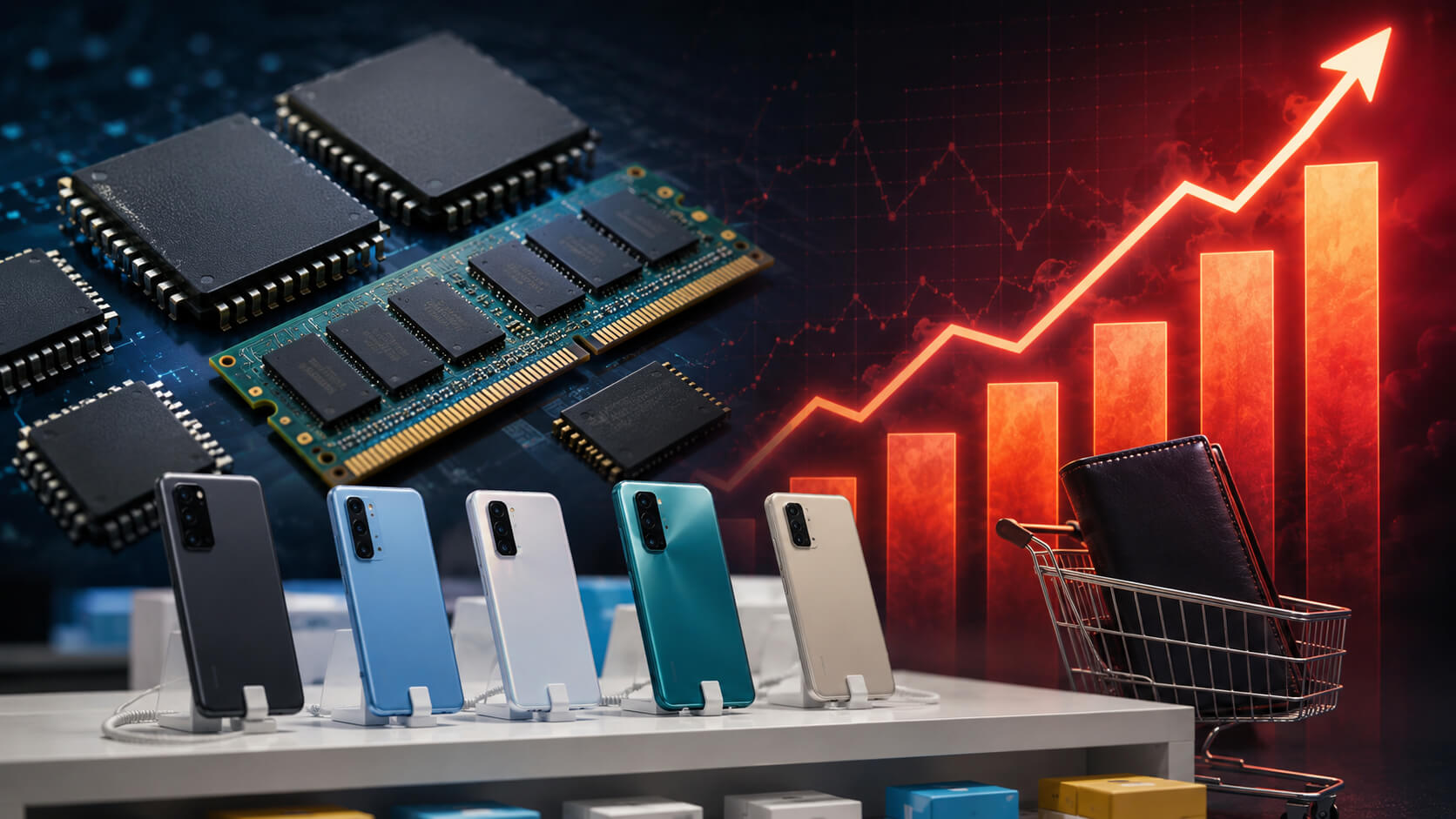
The affordable smartphone market is getting squeezed from an unusual direction.
It is not another camera race. Not a new foldable design. Not even a sudden change in consumer taste.
Memory has simply become much more expensive.
Prices for DRAM and NAND storage are climbing as artificial intelligence companies, cloud providers, and data center operators compete for increasingly valuable semiconductor capacity. Smartphone manufacturers use those same components, but they cannot always match the prices large AI infrastructure companies are prepared to pay.
Premium phones can absorb some of that pressure. Cheap phones cannot.
That difference is beginning to reshape the entire smartphone market.
Rising Memory Prices Hit Budget Smartphones First
Memory is only one part of a smartphone, but it matters much more when the device is already being built on a thin budget.
Manufacturers of low-cost phones carefully balance processors, displays, cameras, batteries, RAM, and storage to reach a specific retail price. There is rarely much room left once production, shipping, marketing, and retailer margins are included.
When memory costs rise, that balance starts to fall apart.
TechNewsWorld reported that memory can represent a particularly large share of the bill of materials in lower-priced devices. Premium smartphones contain more expensive processors, camera systems, displays, and materials, so memory takes up a smaller percentage of the overall manufacturing cost.
For a cheap phone, even a relatively small component price increase can force an uncomfortable choice.
The manufacturer can raise the price, reduce the specifications, accept a smaller profit, or stop selling the model entirely.
None of those options is especially attractive.
Smartphone Brands Are Moving Toward More Expensive Models
The easiest response is also becoming the most obvious one: sell fewer low-end phones and concentrate on models with healthier profit margins.
Omdia analyst Justy Hong said rising memory costs are creating greater polarization across the smartphone market. Vendors are scaling back entry-level product lines while placing more attention on mid-range and premium devices, where buyers are generally less sensitive to price increases.
That does not mean cheap smartphones are about to disappear.
It does suggest that customers may see fewer models, smaller differences between generations, and less aggressive competition at the bottom of the market.
Phone brands have spent years promising more RAM, more storage, better cameras, and faster processors at roughly the same price. That formula becomes difficult when one of the most important components suddenly costs far more than it did before.
Omdia has also warned that the smartphone industry is facing a broader cost reset, noting that mobile memory prices surged sharply during the first quarter of 2026.
Affordable Phones May Offer Less for the Same Price
Manufacturers do not always announce specification cuts.
Sometimes they simply stop upgrading.
A new budget phone might arrive with the same amount of RAM as the previous model. Storage options may remain stuck at 64GB or 128GB. Higher-capacity versions could quietly disappear.
Other compromises may be harder to spot from a specification sheet.
Brands might use smaller camera sensors, remove secondary lenses, choose an older processor, or install slower storage. The device still looks new. The box still carries a new model number. Underneath, the improvement may be fairly small.
That creates a strange situation for consumers.
People could end up paying the same amount—or slightly more—for phones that do not feel significantly better than the devices they already own.
Holding onto an existing phone suddenly makes more sense.
Less RAM Could Make Mobile AI Feel Worse
The memory squeeze arrives at an awkward moment because smartphone makers are trying to add more artificial intelligence features.
On-device AI needs memory.
Features such as live translation, intelligent photo editing, voice assistants, background summarization, image generation, and contextual recommendations can become demanding when they run locally rather than through a cloud server.
A budget device with limited RAM may struggle to keep several apps active while also processing AI tasks. Applications reload more frequently. Multitasking feels slower. Larger AI models may not run at all.
Reduced storage creates a different problem.
Operating systems continue to grow, apps consume more space, and camera files are becoming larger. A phone with modest internal storage can fill up quickly, particularly after several major software updates.
This could produce an increasingly visible divide between premium and affordable smartphones.
Flagship buyers receive the latest AI features and enough memory to use them comfortably. Budget buyers may receive lighter versions, cloud-dependent alternatives, or no support at all.
AI Data Centers Are Competing for the Same Memory Supply
The smartphone industry did not create this problem by itself.
The surge in AI infrastructure is placing extraordinary demand on memory manufacturers.
Companies building AI data centers need high-performance memory for servers, accelerators, and large computing clusters. Those buyers often purchase at a scale that consumer electronics brands cannot easily match. They may also be willing to pay more because memory shortages can delay infrastructure projects worth billions of dollars.
Chipmakers naturally pay attention to where demand and margins are strongest.
That can redirect investment and production toward memory products designed for AI servers rather than low-cost consumer devices.
TechNewsWorld’s analysis links the smartphone pressure directly to data center expansion, arguing that AI infrastructure is straining supply chains that also serve mobile phones and personal computers.
AI is improving what phones can do.
At the same time, the infrastructure supporting that AI may be making affordable phones more expensive to build.
Refurbished Premium Phones Could Become More Attractive
A weaker budget smartphone market may be good news for refurbished device sellers.
Consumers comparing a new entry-level handset with a two-year-old flagship often notice a major difference. The older premium phone may have a better screen, stronger cameras, faster storage, more powerful performance, and higher-quality materials.
Battery condition and software support still matter, of course.
Even so, a professionally refurbished flagship can look more appealing when new budget phones offer limited upgrades.
That shift may encourage smartphone brands to expand trade-in programs, certified pre-owned stores, and longer software support. A device that remains useful for five or six years has more resale value than one abandoned after two.
It also changes what “affordable” means.
For some buyers, the best low-cost phone may no longer be a newly released budget model. It may be last year’s premium device after someone else trades it in.
Emerging Markets Could Feel the Pressure Most
Budget smartphones remain essential across developing and price-sensitive markets.
These devices are often the main way people access banking, education, government services, messaging, online work, transportation, and digital commerce. A meaningful price increase is not a minor inconvenience for buyers operating within strict household budgets.
Manufacturers cannot simply raise prices and assume everyone will follow.
Some customers will delay upgrading. Others will purchase used phones, switch to lesser-known brands, or settle for models with lower specifications.
This is where the market squeeze becomes more than a semiconductor story.
Affordable smartphones have helped bring hundreds of millions of people online. If memory inflation weakens that segment for an extended period, digital access could become more uneven, particularly in regions where laptops and fixed broadband remain out of reach.
Premium Smartphone Innovation Is Unlikely to Slow
The high end of the market is dealing with the same component pressures, but it has more ways to respond.
Apple, Samsung, and other premium manufacturers can negotiate long-term supply agreements, adjust component choices, increase retail prices, or spread higher costs across services and ecosystem revenue.
Their buyers are also more accustomed to expensive upgrades.
A modest price rise on a premium phone may not dramatically change demand. The same increase on an entry-level device can push it beyond the buyer’s budget.
That means flagship phones are likely to keep gaining more memory, stronger AI processors, and advanced camera systems while budget innovation becomes slower and more selective.
The market may still grow technologically.
It just may not grow evenly.
The Cheap Smartphone Formula Is Starting to Break
For years, the smartphone industry relied on a fairly dependable pattern.
Premium features eventually moved down the price ladder. Better cameras reached mid-range phones. Large displays became standard. More RAM and storage appeared in cheaper devices.
Rising memory prices are interrupting that cycle.
Manufacturers now have to protect margins while competing with AI companies for critical components. Some will raise prices. Others will freeze specifications or quietly remove features.
Consumers will notice, even when the marketing avoids mentioning it.
The budget smartphone is not going away. But the idea that every new generation will deliver more hardware for the same money is becoming much harder to maintain.
And this time, the reason may be sitting inside an AI data center rather than inside the phone itself.
Sources
- TechNewsWorld – Soaring Memory Prices Dampen Demand for Budget Smartphones
- Omdia – Smartphone Memory Polarization Deepens Amid Surging Component Costs
- Omdia – The Great Memory Shortage: Surviving the AI-Driven Supply Crisis