

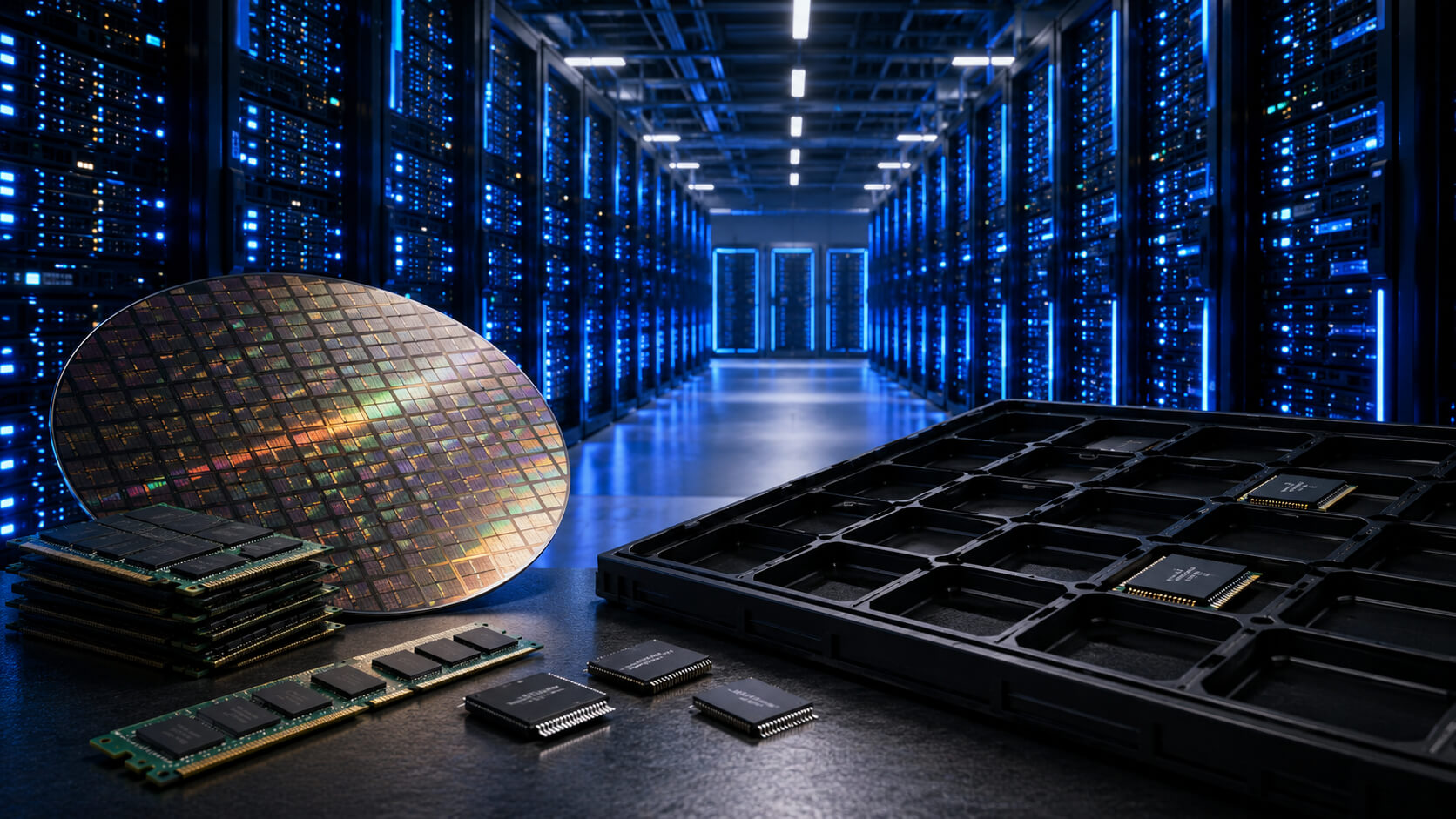
The artificial intelligence boom is creating another problem beyond rising electricity demand and crowded power grids.
It is swallowing memory chips.
Technology companies are racing to build larger AI data centers filled with powerful accelerators, high-performance servers, and enormous amounts of high-bandwidth memory. That construction push is redirecting semiconductor production toward AI infrastructure and away from the ordinary memory used in smartphones, laptops, tablets, and other consumer electronics.
The result is becoming difficult to ignore. Memory prices are rising, supplies are tightening, and manufacturers of everyday devices are being forced to compete with hyperscale cloud companies that can afford to pay much more.
AI is not merely increasing demand for chips. It is changing which customers semiconductor manufacturers prioritize.
AI Servers Consume Far More Memory Than Conventional Systems
A traditional server already needs a considerable amount of memory. An AI server is in another category.
AI models constantly move large volumes of data between processors and memory while training, generating answers, analyzing images, or running complex reasoning workloads. That requires fast memory located close to graphics processing units and other AI accelerators.
TechNewsWorld reported that a single AI server may consume between 10 and 20 times more memory than a server handling conventional workloads. With cloud companies deploying thousands of these systems at once, the pressure quickly spreads across the entire memory supply chain.
The chips receiving the most attention are high-bandwidth memory products, commonly known as HBM. Unlike standard memory modules, HBM stacks multiple DRAM layers vertically to move data at extremely high speeds. It is expensive, complicated to manufacture, and increasingly important to advanced AI systems.
Micron says its HBM4 technology can deliver bandwidth above 2.8 terabytes per second, making it suitable for data-heavy AI and high-performance computing tasks.
That performance is exactly why AI infrastructure companies want so much of it.
Chipmakers Have a Strong Financial Reason to Favor AI
Samsung, SK hynix, and Micron dominate global memory production. All three are investing heavily in AI-oriented memory because the economics are hard to resist.
HBM generally brings higher margins than the standard DRAM used in consumer devices. Large cloud providers can also negotiate multi-year agreements that guarantee purchases at premium prices. For a chipmaker deciding where to allocate limited factory capacity, AI customers look considerably more attractive than a phone manufacturer trying to protect a narrow retail margin.
This is where the shortage becomes uncomfortable for consumers.
HBM and ordinary DRAM may serve different products, but they still compete for manufacturing resources, equipment, engineers, packaging capacity, and semiconductor wafers. More production dedicated to AI memory can mean less capacity available for conventional RAM and NAND storage.
SK hynix has described 2026 as part of an HBM-led memory supercycle, driven by demand for products such as HBM3E and HBM4. Micron has also said that the expansion of AI training, inference, reasoning, and agent-based systems is intensifying demand throughout the memory and storage hierarchy.
The shift is not subtle anymore. It is becoming the center of the memory business.
Consumer Electronics Are Left Fighting for Supply
Phones and laptops do not suddenly stop needing memory because data centers want more of it.
Every modern smartphone requires DRAM for running applications and NAND flash for storing photos, videos, software, and other files. Computers need the same basic components, usually in larger quantities. Gaming consoles, smart televisions, connected vehicles, and networking equipment also rely on these chips.
When suppliers prioritize AI infrastructure, consumer electronics brands face several unpleasant choices.
They can pay more for memory and accept lower profits. They can raise retail prices. They can reduce the amount of RAM or storage included in a device. Some may delay product launches or concentrate on premium models where higher component costs are easier to absorb.
Budget electronics are especially vulnerable.
A flagship phone selling for more than $1,000 may have enough margin to absorb a moderate increase in memory costs. A low-cost handset does not. Even a small component increase can disrupt the pricing plan for a device designed around extremely tight manufacturing margins.
That is how a data center being built for AI training can eventually affect the specifications of an entry-level phone.
The connection sounds distant. It really is not.
Memory Prices Are Already Under Pressure
The TechNewsWorld report cited industry estimates showing steep increases in contract DRAM prices through 2025 and the first half of 2026. One expert told the publication that contract DRAM prices had increased by around 90% during the first quarter of 2026 and another 60% in the second quarter, following a sharp rise throughout 2025.
Those figures should be treated as industry estimates rather than a single universal price for all memory products. Memory pricing varies by chip type, capacity, contract, and customer.
The direction, though, is fairly clear.
SK hynix said in its first-quarter 2026 results that it expected favorable pricing conditions to continue across DRAM and NAND as AI services expanded and memory demand remained strong.
Memory manufacturers are benefiting from the cycle. Device manufacturers are dealing with the bill.
New Factories Will Not Fix the Problem Overnight
Semiconductor shortages tend to encourage investment. Companies expand existing facilities, build fabrication plants, improve production yields, and develop new packaging processes.
None of that happens quickly.
Advanced semiconductor facilities cost billions of dollars. Construction may take years, followed by equipment installation, testing, customer qualification, and a gradual production ramp. HBM adds another layer of complexity because several memory dies must be stacked, connected, packaged, and tested with high precision.
Samsung, Micron, and SK hynix are already expanding their AI memory portfolios. Samsung began commercial shipments of HBM4 in 2026 and later shipped HBM4E samples, while Micron announced volume production of HBM4 designed for Nvidia’s Vera Rubin platform.
More supply is coming.
The awkward part is that AI demand may grow quickly enough to absorb much of that new production. Every capacity increase could be followed by another wave of data center orders.
Relief for consumer memory may therefore arrive slowly rather than through one dramatic correction.
Reusing Components Could Offer Limited Near-Term Relief
Building new factories is not the only option being discussed.
Some industry experts argue that companies should recover usable memory and storage components from retired servers, computers, and other enterprise equipment instead of immediately shredding or recycling complete systems.
That idea will not replace advanced semiconductor manufacturing. Used memory cannot simply be turned into the latest HBM required by new AI accelerators.
Still, recirculating functional components could reduce demand in parts of the enterprise hardware market. Refurbished servers, storage systems, and conventional memory modules may remain useful for workloads that do not require the newest equipment.
It is a practical response to a strange situation: the technology sector is destroying usable hardware while simultaneously worrying that it cannot manufacture enough memory.
Data Center Opposition Will Not Automatically Solve the Shortage
AI data centers are already facing resistance in communities concerned about electricity use, water consumption, noise, land requirements, and pressure on local infrastructure.
Slowing construction could reduce memory demand in certain locations. It would not necessarily reduce global demand by much.
Large cloud providers can move planned investments to regions offering better grid access, faster permitting, cheaper land, or stronger government incentives. A delayed project in one state or country may simply reappear somewhere else.
The more important question is whether AI companies can make their systems less resource-intensive.
Smaller models, improved algorithms, better compression, specialized processors, edge computing, and more efficient inference systems could reduce the amount of hardware required for individual AI workloads. Yet efficiency sometimes creates its own rebound effect. When AI becomes cheaper to operate, companies often deploy more of it.
Better efficiency may slow the pressure. It may also encourage wider adoption.
Both can happen at the same time.
The AI Boom Is Reshaping the Entire Chip Market
The memory shortage is another reminder that AI infrastructure does not exist in isolation.
Every new data center requires processors, memory, storage, networking equipment, cooling systems, electricity, water, construction materials, and skilled workers. Expanding one part of that system can create shortages somewhere else.
For consumers, the effects may appear through higher laptop prices, smaller smartphone storage options, fewer low-cost models, or slower improvements in device specifications.
For chipmakers, AI memory represents one of the most profitable opportunities in the semiconductor industry.
That tension is unlikely to disappear soon.
The AI race was initially described as a competition for the best models and the fastest GPUs. Memory is now moving closer to the center of it. And once memory becomes the bottleneck, the consequences extend well beyond the data center.
Sources
TechNewsWorld: Memory Chip Shortage Aggravated by Rush To Build More Data Centers
Micron Technology – AI Memory at Computex 2026: Micron Powers AI Everywhere at Computex 2026
Micron Technology – HBM4: Official product page
SK hynix – 2026 HBM Market Outlook: Focus on the HBM-led memory supercycle
SK hynix – First-Quarter 2026 Financial Results: Q1 2026 business results
Samsung – Commercial HBM4 Shipments: Samsung ships commercial HBM4
Samsung – HBM4E Sample Shipments: Samsung begins shipment of HBM4E samples
Micron – HBM4 Production for Nvidia Vera Rubin: Micron high-volume production of HBM4