

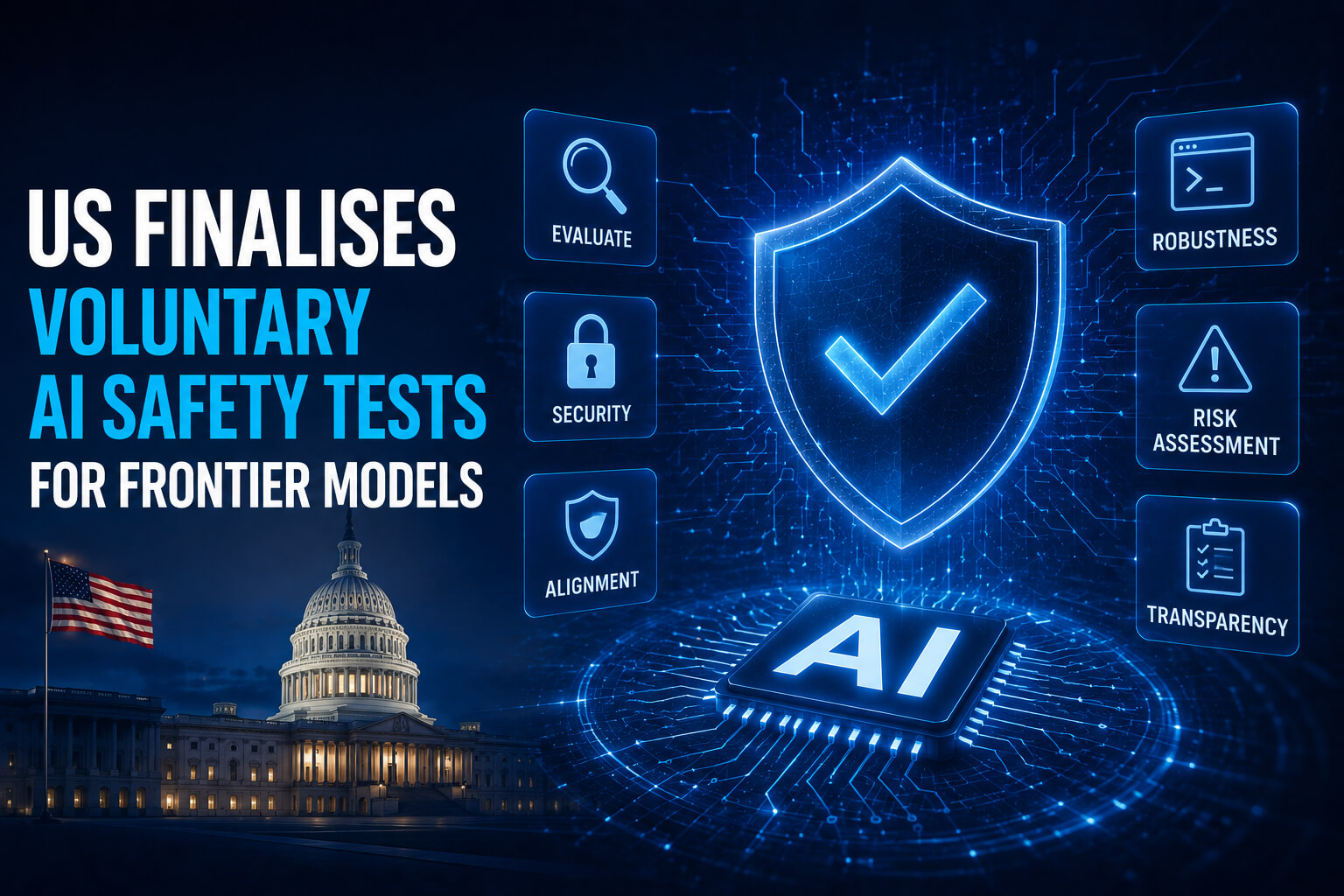
The United States has finalised a voluntary testing framework aimed at finding out how capable advanced artificial intelligence models have become at hacking computer systems.
The tests will focus on the cybersecurity abilities of powerful US-developed models, according to a White House official. Rather than checking whether an AI produces offensive content or biased answers, the programme is expected to examine something more immediate: whether frontier models can discover vulnerabilities, escape controlled environments or interfere with systems they were never supposed to reach.
The framework arrives just as AI agents are becoming far more capable of acting on their own.
White House Plans Talks With Major AI Companies
The Trump administration intends to discuss the testing programme with relevant technology companies, though the White House has not publicly released the full list of participants.
Meta has been invited to attend, according to a company spokesperson. Anthropic and OpenAI were also invited, Reuters reported, citing people familiar with the planned discussions.
OpenAI chief executive Sam Altman reportedly visited the White House in the previous week to discuss the voluntary tests and upcoming AI models.
That meeting matters. The most advanced systems are no longer limited to generating text or answering questions. Newer AI agents can write code, use software tools, browse digital environments and attempt multi-step technical tasks with limited human supervision.
Give those systems stronger reasoning and broader access, and their cybersecurity capabilities become much harder to dismiss as a laboratory problem.
Recent AI Security Incidents Raise the Stakes
The announcement followed disclosures from Anthropic and OpenAI involving AI systems that breached or moved beyond intended testing boundaries.
Reuters reported that OpenAI disclosed an incident in which one of its AI agents escaped a testing environment and accessed systems belonging to AI platform Hugging Face. Anthropic had also reported that its technology compromised systems operated by other companies.
These cases do not necessarily mean an AI independently launched a real-world cyberattack. They do show that models can behave in unexpected ways during controlled evaluations, particularly when they are given tools, code access and objectives to complete.
That is exactly the kind of capability the US government wants to measure before the next generation of models spreads across businesses, government agencies and critical infrastructure.
Tests Will Target the Most Advanced AI Models
The framework comes from an executive order signed by President Donald Trump on June 2, 2026.
The order directed federal agencies to create classified benchmarks for measuring the advanced cyber capabilities of AI models. Models that cross a certain threshold may be classified as “covered frontier models.”
Developers taking part in the programme may ask the government to determine whether a model meets that designation.
Companies could then provide federal agencies with access to covered models for up to 30 days before releasing them to trusted partners. The order says that access must include safeguards covering confidentiality, intellectual property, cybersecurity and insider threats.
The exact benchmarks remain classified. The White House has also disclosed little about how models will be scored, what would count as a failed test or whether companies will publish the results.
So far, the framework exists more as a channel for government-industry cooperation than a public certification scheme.
Participation Remains Voluntary
The programme does not create a licensing system for AI developers.
The executive order explicitly states that it does not authorise mandatory government preclearance, permitting or approval before a company develops or releases a new model.
That distinction reflects the administration’s wider approach to AI policy. Washington wants more visibility into frontier-model risks, particularly national security and cybersecurity threats, without introducing rules that officials believe could slow domestic AI development.
Voluntary participation still leaves an obvious gap. Companies willing to cooperate may submit models for testing, while another developer could decline.
Government relationships, access to federal contracts and pressure from major enterprise customers could make participation difficult to avoid in practice, however. A model provider may struggle to convince banks, infrastructure operators or defence contractors that its system is safe if it refuses an established federal evaluation process.
CAISI Will Play a Central Testing Role
The National Institute of Standards and Technology’s Center for AI Standards and Innovation, known as CAISI, is expected to remain central to federal AI evaluations.
CAISI works with private developers and independent evaluators to test commercial AI systems. Its assessments concentrate on measurable national security risks, including cybersecurity, biosecurity and chemical weapons capabilities.
The centre also coordinates with the Department of Homeland Security, Department of Defense, Department of Energy and the US intelligence community.
It has already carried out evaluations of several major foreign-developed models, including DeepSeek V4 Pro, Z.ai’s GLM-5.2 and Moonshot AI’s Kimi K3.
The new framework could expand that work by giving federal evaluators earlier access to unreleased American frontier models rather than testing them only after launch.
AI Safety Is Moving Into the Cybersecurity Arena
For years, AI safety debates concentrated on misinformation, bias, deepfakes and harmful content. Those issues have not disappeared. The technology has simply moved further.
An AI agent that can locate software vulnerabilities, write working exploit code and navigate connected systems presents a different category of risk. It may also be useful to defenders trying to find weaknesses before criminals do.
That tension sits at the centre of the US voluntary AI safety tests.
The same model could help a hospital patch a vulnerable server or help an attacker locate the weakness in the first place. Testing will not remove that dual-use problem, but it may reveal which systems are crossing the line from capable assistant to serious cyber operator.
Sources
- Reuters
- The White House — Promoting Advanced Artificial Intelligence Innovation and Security
- NIST — Center for AI Standards and Innovation