

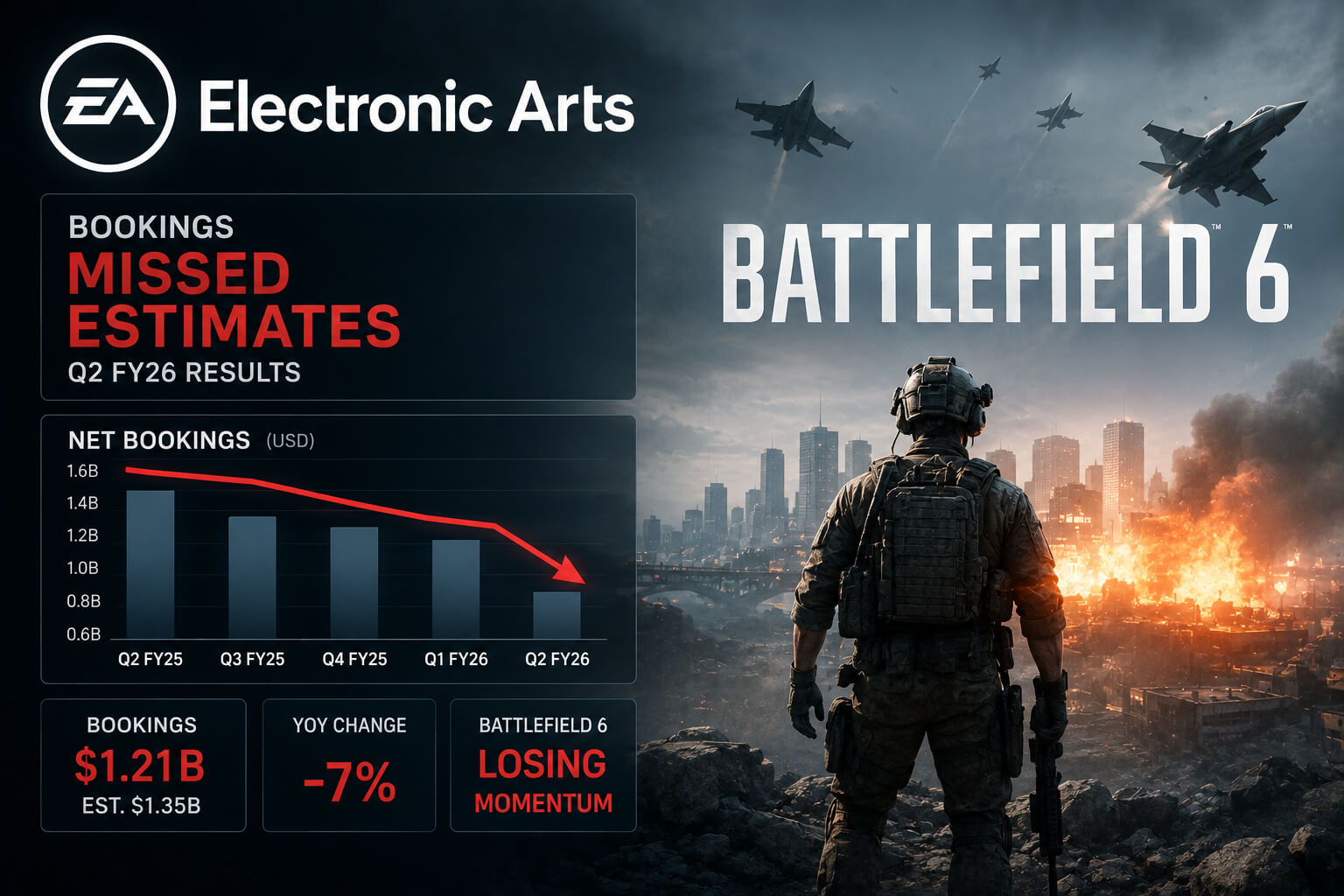
Electronic Arts has fallen short of Wall Street’s quarterly bookings forecast, with the early excitement around Battlefield 6 proving difficult to sustain.
The video game publisher reported net bookings of $1.35 billion for its first fiscal quarter, below the $1.48 billion average estimate from analysts surveyed by LSEG. The gap was not small enough to brush aside, especially with EA preparing to leave the public market through a Saudi-backed takeover worth $55 billion.
Profit still moved sharply higher.
EA posted quarterly profit of $397 million for the three months ended June 30, almost double the $201 million recorded during the same period a year earlier. Stronger profit does not entirely remove the concern around bookings, though. For a publisher built around annual releases and long-running online games, future player spending matters just as much as the current quarter.
Battlefield 6 Engagement Cools After Its Big Launch
Battlefield 6 arrived with plenty of momentum. EA described the game as a major driver of its record fiscal 2026 performance, and earlier results showed the title setting franchise engagement records following its launch.
That initial rush has started to fade.
Player engagement dropped after launch, according to Reuters, raising questions over how long EA can keep users active and spending inside the game. A strong release week can sell millions of copies. The harder part is keeping those players around once the novelty wears off.
This is where the numbers begin to matter.
EA increasingly relies on live-service revenue, including digital content, subscriptions and in-game purchases. These systems stretch a game’s commercial life well beyond its original release date. When engagement falls, the publisher loses more than active players. It risks losing recurring spending on battle passes, cosmetics and downloadable content.
Battlefield 6 is not necessarily in trouble. But it now has to prove it can operate as a long-term platform rather than a blockbuster that burns brightly and then slips down the charts.
Electronic Arts Still Depends Heavily on In-Game Spending
EA owns some of the industry’s most reliable franchises, including EA Sports FC, Madden NFL, Apex Legends and Battlefield.
The business no longer revolves solely around selling a boxed game once a year. EA wants players returning every week, buying digital items and moving from one season of content to the next. Its investor materials place live services and online communities at the centre of the company’s growth strategy.
That model can produce steady revenue when a title is healthy. It can also expose weaknesses quickly.
Players have endless alternatives. A slow content update, a poorly received patch or a major rival launch can pull attention away almost overnight. Publishers then have to spend more on new content, marketing and player acquisition just to recover ground.
The bookings miss suggests EA did not extract as much spending from its catalogue as analysts had expected during the quarter.
Grand Theft Auto VI Adds Another Problem
EA is also heading toward a crowded period for premium games.
Take-Two Interactive’s Grand Theft Auto VI is expected to dominate attention when it reaches the market. Few releases carry that kind of weight. Players may delay other purchases, abandon existing games for weeks or move their discretionary spending toward Rockstar Games’ blockbuster.
That does not mean every competing title disappears. Sports games have loyal annual audiences, while free-to-play releases can keep generating revenue without requiring another full-price purchase.
Still, there is only so much time and money to go around.
The pressure will be particularly sharp for games such as Battlefield 6, which need large, active multiplayer communities. Empty servers and slower matchmaking can create their own decline. Players leave because other players have already left.
Saudi-Backed EA Buyout Moves Closer
The earnings update arrived just as EA’s proposed $55 billion take-private deal moved through another regulatory hurdle.
Saudi Arabia’s Public Investment Fund, private equity firm Silver Lake and Affinity Partners are behind the acquisition. The European Union approved the transaction in late July, clearing one of the remaining barriers to completion.
Under the agreement, EA shareholders are set to receive cash for their shares, while the company will operate away from the quarterly scrutiny that comes with being publicly traded.
That could give EA more room to make expensive, long-term bets. Game development cycles now stretch across several years, and one delayed release can distort an entire financial calendar.
Private ownership brings its own pressure, however. The deal includes significant debt financing, meaning EA’s new owners will still expect strong and predictable cash generation.
A bookings miss will not derail a transaction of this size. It does offer a reminder of what the buyers are inheriting: valuable franchises, recurring digital revenue and a player base that can shift its attention very quickly.
EA Enters Private Ownership With Work Still to Do
Electronic Arts remains profitable, and its collection of sports, action and online franchises gives it a stronger foundation than most publishers.
The latest quarter was not a collapse. Profit climbed, and Battlefield 6 is still capable of generating revenue through future seasons and content updates.
The weak bookings figure cuts through the takeover excitement, though.
EA’s next chapter will depend on whether it can turn big launches into durable gaming communities. Getting millions of people through the door is one thing. Convincing them to stay — and continue spending — is the part that now needs attention.
Sources
- Reuters
- Electronic Arts Investor Relations
- Electronic Arts Q4 and FY26 Results
- Channel NewsAsia – Reuters Report