

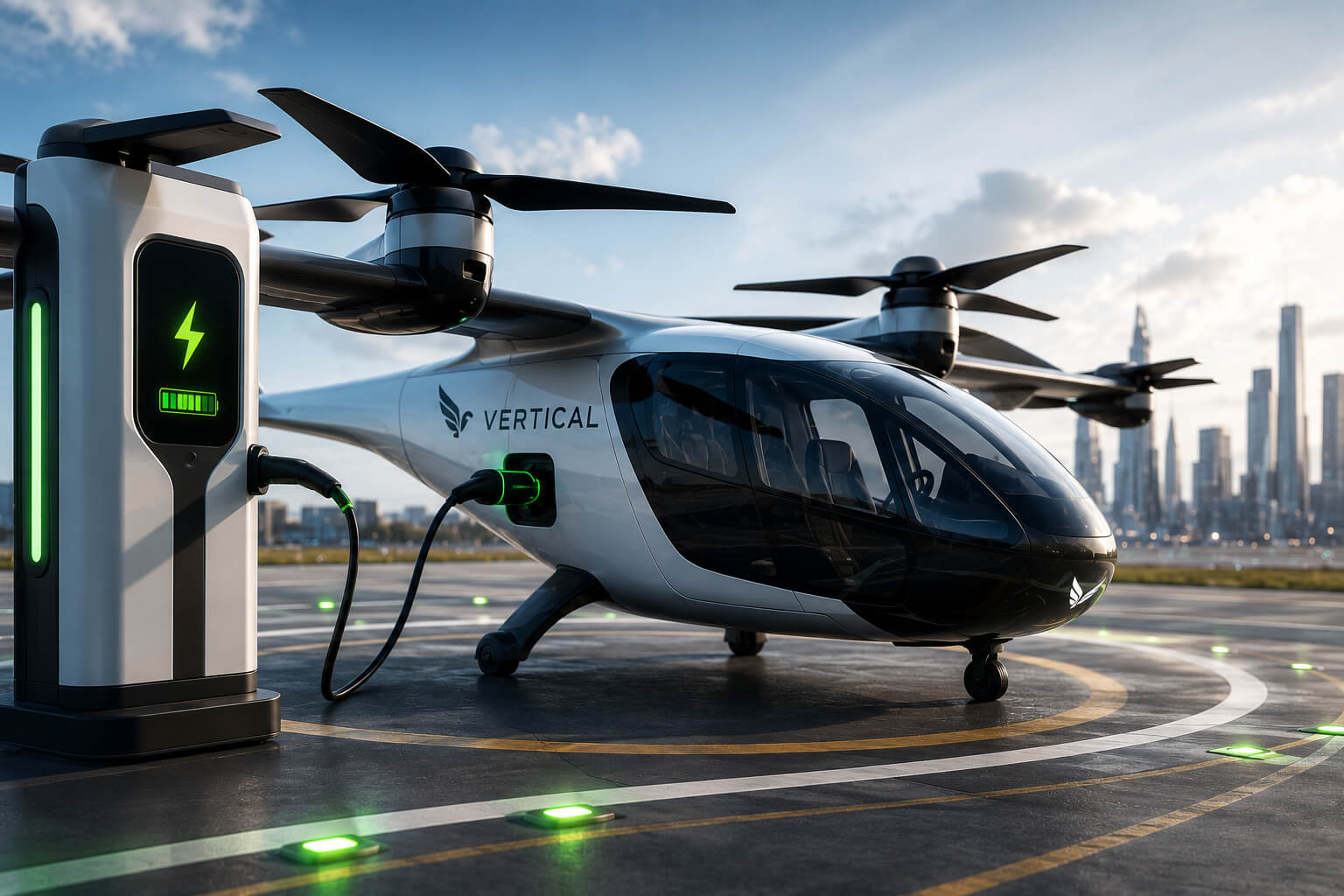
Electric aircraft cannot spend half the day parked beside a charger.
That is the practical problem Vertical Aerospace now wants to tackle through a new UK-backed programme focused on high-power charging and thermal management technology.
The Bristol-based aerospace company will lead the ECLiPSE project, short for Electrified Charging and Liquid-cooling Provision for Support of E-flights. The programme carries a total project value of roughly £3.4 million and includes up to £1.75 million in government funding.
Vertical will work with the University of Bath and engineering consultancy InnCat Ltd. to develop charging systems that could reduce aircraft turnaround times, lower infrastructure costs and make frequent electric flights more realistic.
Electric Aviation Has a Ground Problem
Most attention around electric aviation goes to the aircraft itself. Batteries, propellers, certification and flight range usually dominate the conversation.
Charging is less glamorous. It may also decide whether the business model works.
An electric vertical take-off and landing aircraft, or eVTOL, could complete several short journeys in a day. That only makes financial sense when operators can recharge it quickly between flights. Long charging sessions would leave expensive aircraft sitting idle while passengers wait.
Airports and vertiports also need equipment that can deliver large amounts of electricity safely without requiring oversized, costly installations.
Vertical Aerospace says ECLiPSE will address both sides of that problem. The project will combine high-power charging with liquid-cooling technology, aiming to improve charging performance while reducing system size, installation complexity and long-term operating costs.
The ECLiPSE Project Is Bigger Than a Faster Charger
Pushing more power into an aircraft battery creates heat. A lot of it.
That means faster charging cannot simply come from installing a more powerful electrical connection. The charging cable, battery system and supporting electronics must remain within safe operating temperatures.
ECLiPSE will develop an integrated approach in which advanced cooling supports higher charging power. Better thermal control could allow an aircraft to recharge faster without placing excessive stress on the battery or surrounding equipment.
The programme will also study how operators can install the technology more easily at aviation sites. That part matters because many airports were never designed around battery-electric aircraft.
Adding high-capacity electrical systems can involve grid upgrades, construction work and expensive cooling hardware. A smaller, more efficient charging platform could make deployment easier at regional airports and future urban air mobility hubs.
UK Government Funding Pushes Electric Flight Beyond Prototypes
The UK Department for Transport selected ECLiPSE through its Zero Emission Flight Demonstrator programme.
Government records place the project cost at £3,372,793, with £1,752,747 coming from the department. The work will take place across South West England and South Wales.
ECLiPSE is one of eight projects receiving support under a £7.3 million funding round announced on July 23, 2026. The selected projects cover technologies including electric aircraft charging, hydrogen storage and other infrastructure needed to support zero-emission aviation.
The funding sits within a broader UK government package of up to £43 million for green aviation research and development. That programme is intended to move zero-emission flight technologies out of controlled demonstrations and closer to commercial use.
This is where aviation policy becomes less theoretical. Developing a cleaner aircraft is one step. Airports still need to refuel or recharge it, ground crews need workable procedures, and regulators need evidence that the full system can operate safely.
Vertical Aerospace Is Building Around Its Valo Aircraft
Vertical Aerospace is developing Valo, a piloted electric aircraft designed to carry four passengers. The aircraft uses vertical take-off and landing technology, allowing it to operate without a traditional runway.
The company says the all-electric version will produce no operating emissions. It is also developing a hybrid-electric model intended to offer longer range and greater mission flexibility.
Vertical reports about 1,500 Valo pre-orders from customers across four continents. Its customer list includes American Airlines, Avolon, Bristow, GOL and Japan Airlines, although some commitments remain subject to third-party arrangements and future commercial conditions.
Building charging infrastructure gives Vertical a role beyond aircraft manufacturing. It places the company inside the wider electric aviation ecosystem, where aircraft, energy systems, airport infrastructure and flight operations all depend on one another.
A technically impressive eVTOL will not achieve much if operators cannot recharge it quickly enough to maintain a useful schedule.
Faster Turnarounds Could Shape Electric Aviation Economics
Commercial aviation measures time closely. Every minute spent on the ground affects aircraft utilisation, staffing and revenue.
That pressure may become even sharper for short-distance eVTOL services. A journey lasting 20 minutes cannot be followed by an inconveniently long charging stop. Operators would need rapid, repeatable turnaround cycles throughout the day.
Higher charging power could shorten those stops. Improved cooling may also protect equipment performance during repeated charging sessions, particularly when several aircraft use the same site.
There is still work ahead. The programme must turn its technical targets into systems that operate reliably under real aviation conditions. Grid capacity, battery degradation, certification and infrastructure investment will remain difficult questions.
Even so, ECLiPSE focuses on a problem the industry cannot avoid.
Electric aviation needs aircraft that fly. It also needs charging systems that do not slow the entire operation down.
Charging Technology May Reach Other Transport Markets
Vertical Aerospace expects parts of the technology developed through ECLiPSE to have uses beyond aviation.
High-power charging and liquid-cooling systems are becoming relevant across heavy transport, including electric trucks, buses, marine vessels and specialised industrial vehicles. These machines often need large amounts of energy but cannot remain out of service for long periods.
A charging platform built for aircraft would face strict requirements around weight, safety, reliability and heat management. Lessons from that environment could eventually influence charging equipment used in other demanding transport sectors.
That wider potential makes the project more than a single-company aircraft initiative. It could contribute to the broader engineering challenge of electrifying machines that require far more power than a passenger car.
Electric Flight Will Depend on What Happens Between Flights
The electric aviation market has spent years showing that battery-powered aircraft can leave the ground.
The next stage is less dramatic but more important: making the system usable every day.
Vertical Aerospace’s ECLiPSE programme is aimed squarely at that gap. Faster charging, better cooling and simpler installations could help electric aircraft complete more flights while keeping infrastructure costs under control.
None of this guarantees that commercial eVTOL networks will arrive quickly. Aircraft certification, public acceptance, airspace integration and operating economics still have to line up.
But charging can no longer sit in the background.
For commercial electric aviation, what happens on the ground may determine how often these aircraft ever reach the sky.
Sources
- Business Wire – Vertical Aerospace to Develop High-Power Charging Technology
- UK Government – Zero Emission Flight Demonstrator Successful Projects
- UK Government – Over £7 Million to Fuel Zero-Emission Flight
- UK Government – £43 Million Boost for Green Aviation
- Innovate UK – Zero Emission Flight Demonstrator Competition