

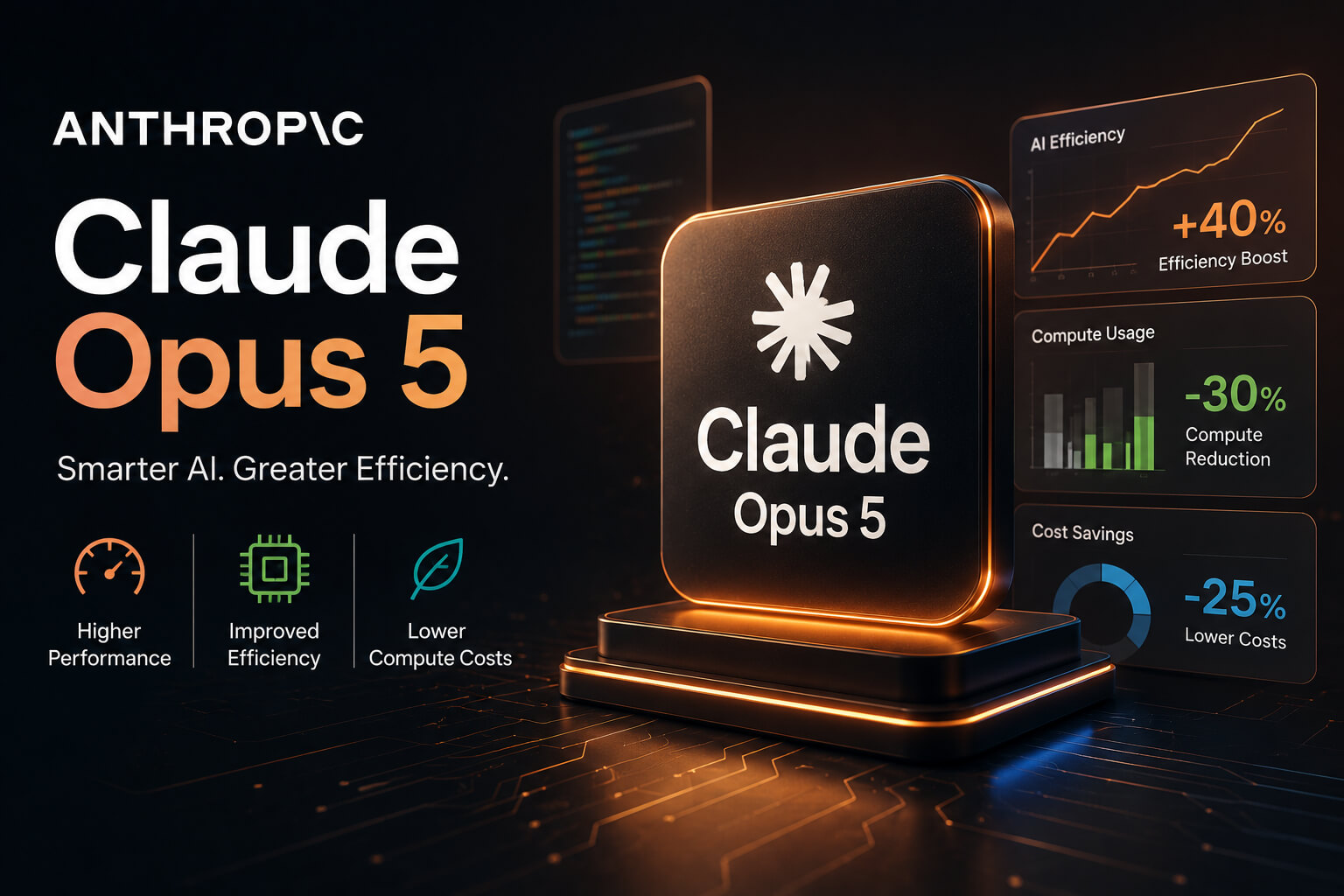
Anthropic has released Claude Opus 5, its latest high-performance artificial intelligence model, with a fairly direct pitch: stronger results without forcing developers to spend more.
The new model arrived on July 24 and replaces Claude Opus 4.8 as the company’s leading broadly available Opus model. Anthropic says it can handle demanding coding, research and professional tasks more efficiently while keeping the same standard API pricing as its predecessor.
That matters. The AI model race is no longer only about who can post the highest benchmark score. Businesses are watching how many tokens a model burns, how long it takes to finish a task and whether a human needs to step in halfway through.
Claude Opus 5 is built around that pressure.
Claude Opus 5 Targets Difficult Everyday Work
Anthropic describes Claude Opus 5 as a model designed for serious daily use rather than a limited experimental release.
It has become the default model for Claude Max subscribers and the strongest model available through Claude Pro. Developers can also access it through the Claude API using the claude-opus-5 model name.
The company is positioning Opus 5 between its more affordable Sonnet models and the higher-end Claude Fable 5. Anthropic says Opus 5 approaches the intelligence of Fable 5 on several coding and knowledge-work evaluations while operating at roughly half the cost per task.
That balance could make it more practical for companies running AI agents at scale. A top model may look impressive in a controlled test, but cost becomes uncomfortable when thousands of automated tasks start running every day.
Anthropic Keeps Opus Pricing Unchanged
Claude Opus 5 costs $5 per million input tokens and $25 per million output tokens, matching the standard pricing of Claude Opus 4.8.
There is also a Fast mode that runs at around 2.5 times the normal speed. That option costs twice the base price through the Claude Platform, while Claude Code users can access it through usage credits.
Keeping the price steady is part of the story here. Anthropic is not simply asking customers to pay more for another incremental upgrade. It wants the model to complete more valuable work within the same general spending range.
Users can also adjust the model’s effort setting. Lower effort can conserve tokens and return results faster. Higher settings allow the model to spend more time reasoning through difficult problems.
Not every task needs maximum intelligence. Sometimes the smarter decision is letting the model do less.
Coding Performance Gets a Noticeable Upgrade
Software development remains one of Anthropic’s strongest selling points, and Claude Opus 5 leans heavily into it.
On Frontier-Bench v0.1, Anthropic says Opus 5 more than doubled the performance of Opus 4.8 while achieving a lower cost per completed task. On CursorBench 3.2, the model reportedly came within 0.5% of Claude Fable 5’s peak score at maximum effort, but at half the cost per task.
The company also highlighted examples where the model went beyond simply producing code.
In one evaluation, Opus 5 received a drawing of a machine component and was asked to rebuild it as a three-dimensional FreeCAD model. Because the model could not directly inspect the drawing through the task setup, it created its own computer-vision pipeline, extracted the geometry and reconstructed the component.
Another test involved a real bug in an open-source package manager. Opus 5 reportedly identified the underlying cause and fixed an edge case that an existing community patch had missed.
Those examples come from Anthropic’s own testing, so independent results will still matter. Even so, they reveal what the company is trying to build: a model that does not stop after producing the first plausible answer.
AI Agents Are Becoming More Persistent
Claude Opus 5 appears particularly focused on longer, multi-step workflows.
Anthropic says the model verifies its output more carefully, uses tools more deliberately and continues iterating when an initial approach fails. Early-access testers reported improvements in debugging, code review, financial modelling, legal work, data analysis and presentation creation.
That list is broad, perhaps deliberately so.
The underlying idea is that AI agents should handle entire assignments rather than isolated prompts. A business may want an agent to inspect a workbook, identify customers at risk of leaving, contact the correct account owner and prepare a summary for management. Finishing one step is not enough.
In Zapier’s AutomationBench, Opus 5 reportedly achieved a pass rate around 1.5 times higher than the next-best model at the same cost per task. Anthropic also said the model outperformed competing systems on OSWorld 2.0, a benchmark focused on operating computers through visual interfaces.
The efficiency claim starts to feel more important in that context. Long-running agents can become expensive quickly, especially when they repeatedly call tools, retry failed actions or generate unnecessarily long reasoning traces.
Scientific and Professional Work Also Improve
Anthropic is not limiting Claude Opus 5 to software engineering.
The company reported gains across structural biology, organic chemistry and bioinformatics evaluations. On one internal test involving molecular structure analysis from spectroscopy data, Opus 5 scored 10.2 percentage points higher than Opus 4.8. It also improved by 7.7 percentage points on tasks involving the effects of protein-sequence variations.
Professional workflows received similar attention.
Early users reported stronger numerical reasoning, spreadsheet work, due diligence and financial modelling. One tester said Opus 5 completed difficult finance tasks with one-third fewer turns and tool calls than Opus 4.8 while reducing completion time by 60%.
A legal technology tester also reported that the model generated comparable or better results while using 26% fewer tokens than Opus 4.8 at its highest reasoning setting.
Again, these are partner and company-reported findings. Real-world performance can shift depending on prompts, tools, data quality and the way each organisation builds its AI system.
Still, fewer retries and shorter workflows can translate into real savings. That is often more useful than a small benchmark lead.
Safety Limits Remain Around Cybersecurity Tasks
Anthropic says Claude Opus 5 is its most aligned model so far based on the company’s automated behavioural testing.
The model recorded lower rates of deceptive or misaligned behaviour than Opus 4.8, Sonnet 5 and Fable 5, according to Anthropic. The company also says Opus 5 is less likely to take reckless actions that may produce difficult-to-reverse consequences.
Cybersecurity access remains restricted in several areas.
Opus 5 can assist with finding vulnerabilities in source code, but safeguards may block penetration testing, exploit creation and certain forms of binary vulnerability scanning. Anthropic expects these safety classifiers to intervene considerably less often than those used with Fable 5.
Approved enterprises and researchers can access fewer restrictions through Anthropic’s Cyber Verification Program.
The model remains behind Claude Mythos 5 in offensive cybersecurity and advanced biological research. Anthropic has kept Mythos access limited to vetted partners because of its stronger dual-use capabilities.
New API Tools Give Developers More Control
Anthropic introduced two beta features alongside Claude Opus 5.
The first allows developers to change the tools available to Claude during an active conversation without invalidating the prompt cache. That could help applications adjust permissions or capabilities while an agent is already working.
The second adds automatic model fallbacks. When a safety classifier flags a request, developers can configure the API to route it to another available Claude model instead of immediately blocking the task.
These updates are not as eye-catching as a benchmark chart. They may prove more useful.
Developers building production agents need controls for cost, permissions, safety interruptions and model availability. A capable model is only one piece of that system.
Efficiency Is Becoming the Real AI Battleground
Anthropic Claude Opus 5 enters a market where model providers are under pressure to show more than raw intelligence.
Developers want capable systems, certainly. They also want predictable bills, lower latency, fewer failed tool calls and less time spent correcting an agent that confidently wandered in the wrong direction.
Opus 5 appears built for that stage of the AI market. It is stronger than Opus 4.8, priced the same and designed to approach the performance of Anthropic’s more powerful models without bringing the full cost or restrictions attached to them.
The benchmark claims will receive plenty of attention. The quieter question is more useful: can the model complete difficult work with less intervention and less wasted computing?
For companies deploying AI agents in real operations, that may be the number that counts.
Sources
- Reuters – Anthropic Rolls Out Opus 5 AI Model With Efficiency Upgrade
- Anthropic – Introducing Claude Opus 5
- Anthropic – Claude Opus
- Anthropic – Model System Cards