

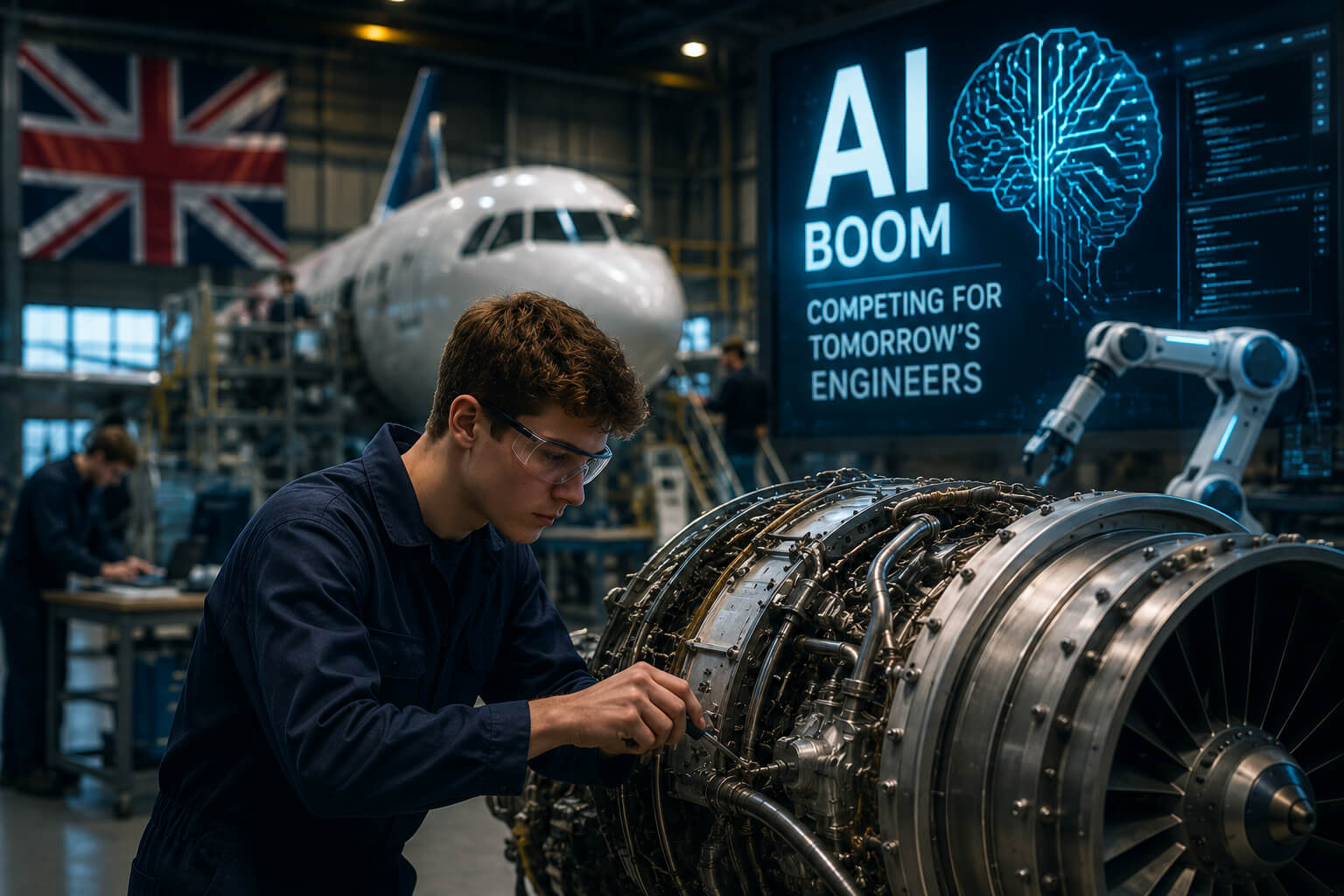
The aircraft were loud, fast and difficult to ignore at the Farnborough International Airshow. For aerospace companies, though, the real contest was happening on the ground.
Britain’s aerospace and defence industry is trying to convince a new generation of engineers that building aircraft, missiles and unmanned systems can still compete with a career in artificial intelligence.
That pitch is becoming harder.
The UK aerospace and defence sector lacks around 10,000 specialist engineers each year. Meanwhile, AI companies and other technology employers are chasing many of the same graduates, often with higher salaries, more flexible working conditions and a much simpler route into the industry.
Britain’s Aerospace Workforce Is Getting Older
The recruitment problem is not only about filling today’s vacancies. Aerospace companies also need to replace experienced engineers who are approaching retirement.
More than half of Britain’s licensed aerospace engineers are over 50 years old. Fewer than 10% are under 30, according to figures cited from a Royal Aeronautical Society report.
That is a difficult age gap to ignore.
The UK aerospace sector has grown by 31% over the past decade, yet its supply of skilled workers has failed to grow at the same speed. Companies now face larger order books, rising defence demand and ambitious technology programmes without enough engineers to carry the work forward.
Airbus and Boeing are already working through record aircraft backlogs. Production cannot simply accelerate because airlines want more planes. Manufacturers need engineers, technicians and skilled factory workers, and many of the people with decades of experience are gradually leaving the workforce.
AI Companies Are Offering Engineers a Different Path
Aerospace once stood near the top of the list for young people who enjoyed physics, engineering and complex machines.
Now it shares that space with AI laboratories, robotics companies, autonomous vehicle startups and software firms.
The underlying skills often overlap. A graduate with experience in mathematics, simulation, machine learning or advanced systems could work on an aircraft platform. The same graduate could also join an AI company where the recruitment process may be faster and the salary considerably more attractive.
Jerrold Lundquist of advisory firm The Lundquist Group said graduates from major engineering institutions could increasingly choose companies such as Anthropic or OpenAI instead of Boeing or Airbus.
It is not hard to see why. AI roles often carry strong pay premiums and may include benefits such as remote work and flexible career routes. Research into AI-related vacancies has also found that employers increasingly focus on demonstrated skills rather than traditional degree requirements, widening the pool of people who can enter the field.
Aerospace remains more tightly regulated. Its projects move slowly, safety requirements are demanding and employees may wait years before seeing the final product take flight.
For some graduates, that patience still feels worthwhile. Others want quicker results.
Years of Cutting Apprenticeships Are Now Being Felt
The industry did not arrive at this shortage overnight.
Some aerospace companies reduced apprenticeship and feeder programmes during earlier cost-cutting periods. Those schemes once gave young workers a structured way to learn technical skills while building long-term careers inside the industry.
Graduate schemes and entry-level recruitment campaigns have replaced part of that pipeline. They have not fully rebuilt it.
At Farnborough, companies used engine-building exercises, competitions, flight demonstrations and recruitment stands to get younger visitors interested. The spectacle worked. Teenagers stopped, asked questions and imagined themselves inside the industry.
The harder part comes after the airshow.
A flashy aircraft display can create excitement for a day. Keeping that interest alive through school, university and early employment requires sustained investment.
Flying Taxis and Cleaner Aviation Could Help
Aerospace employers are not relying only on traditional passenger aircraft to win young recruits.
Electric flight, sustainable aviation, autonomous systems and flying taxis give the sector a newer story to tell. These programmes sit closer to the technologies younger engineers already encounter through robotics, software and AI.
They also address one of aerospace’s image problems.
Aviation remains closely linked with fossil fuel use and carbon emissions. Young engineers who want their work to support climate goals may hesitate before joining the industry. Projects involving hydrogen propulsion, electric aircraft and more efficient flight systems could make the field feel more relevant.
There is also a slightly awkward twist here. AI may be pulling engineers away from aerospace, but aerospace companies need AI talent to build their next generation of products.
Autonomous aircraft, predictive maintenance, digital twins and advanced manufacturing all depend on software and machine learning. Industry groups in both the UK and the United States now identify AI, automation and digital fluency as critical workforce priorities.
The two sectors are not separate anymore. They are competing while becoming increasingly dependent on each other.
Defence Spending Gives Aerospace Another Recruitment Argument
Rising defence spending may offer the sector some help.
European governments have increased investment in military technology following Russia’s war in Ukraine. That has created new demand for drones, missiles, surveillance systems and autonomous defence platforms.
At Farnborough, BAE Systems displayed Brontanax, a full-scale model of its unmanned combat aircraft concept. Projects such as this give recruiters something more futuristic to place in front of young engineers.
Defence work also offers long-term contracts and a sense of national purpose, though ethical concerns may discourage some applicants.
Britain’s aerospace, defence, security and space industries contributed £46.8 billion to the UK economy in the previous year, according to ADS. The sector is not shrinking. Its challenge is finding enough people to support that growth.
Recruitment Must Start Before Students Reach University
The airshow revealed something else. Interest still exists.
Seventeen-year-old volunteer Hassan Butt told Reuters that he hoped to pursue aerospace engineering, with a particular interest in missiles. Another student, Molly Haydon, said companies needed to do more to educate young people, especially young women, about the jobs available in the sector.
That may be the most practical starting point.
Aerospace companies cannot wait until engineering students begin comparing graduate salaries. By then, technology companies are already competing for them.
Recruitment needs to begin in schools through practical programmes, visible role models, modern apprenticeships and clearer explanations of what aerospace engineers actually do.
Young people still look up when an aircraft crosses the sky. Turning that moment into a career is the part the industry has allowed to become too uncertain.
Aerospace Cannot Win With Nostalgia Alone
The aerospace industry has history, prestige and some of the most technically demanding work in engineering.
None of that guarantees a future workforce.
AI companies have changed what young engineers expect from a technology career. They offer faster development cycles, aggressive salaries and a feeling that their work sits at the centre of the next economic transformation.
Aerospace must respond with more than dramatic flight displays and familiar stories about the wonder of aviation. It needs stronger training routes, competitive working conditions and a clearer connection between its traditional engineering strengths and technologies such as AI, robotics and clean propulsion.
The planes still capture attention.
Now the industry has to prove that the careers behind them are just as exciting.
Sources
- Reuters – Aerospace fights for young recruits as AI drains talent pool
- Aerospace Industries Association – Study on aerospace and defence talent gaps
- ManpowerGroup UK – Mission 2030: Closing Talent Gaps in Aerospace and Defence
- arXiv – Beyond Pay: AI Skills Reward More Job Benefits
- arXiv – Skills or Degree? The Rise of Skill-Based Hiring for AI and Green Jobs