

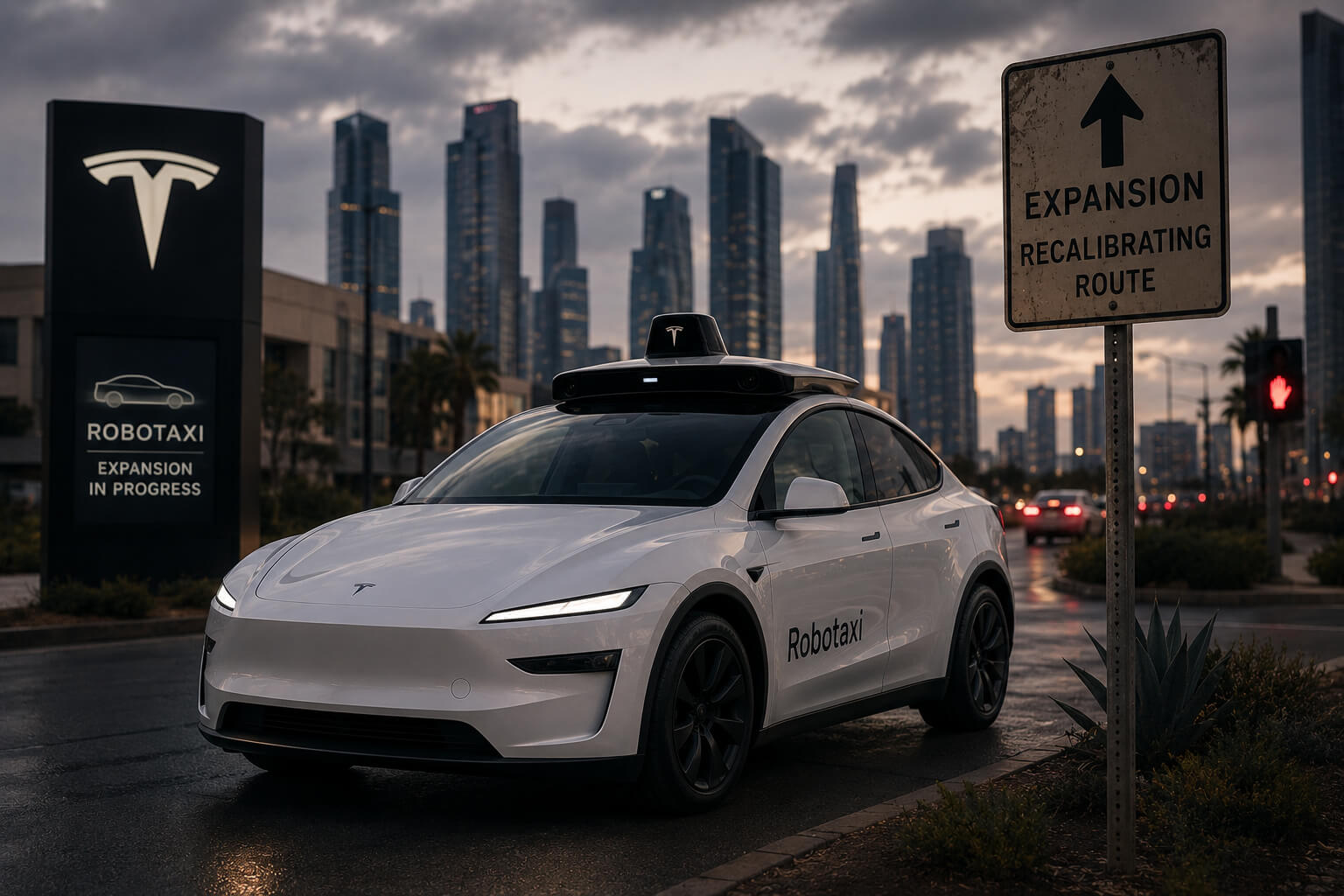
Tesla spent years talking about robotaxis as though a nationwide rollout was sitting just around the corner. The language was bold, even by Elon Musk’s standards.
That confidence now sounds different.
During Tesla’s latest earnings call, Musk and other executives spoke more carefully about the company’s autonomous ride-hailing business. Instead of promising rapid coverage across the United States, they talked about local regulations, operational problems, safety and the need to test smaller fleets before adding hundreds of vehicles.
It was a noticeable change. Investors noticed too.
Tesla shares dropped sharply on July 23 after the company provided few new expansion targets and admitted that its robotaxi rollout was moving more slowly than many had expected. Barclays analysts said Tesla still needed to prove that its autonomous driving capabilities were reaching a genuine turning point.
Tesla’s Robotaxi Promises Have Met a Slower Reality
A year earlier, Musk said Tesla’s robotaxi network could expand at a “hyper-exponential” rate and reach half of the US population by the end of 2025.
That did not happen.
Tesla launched its first small robotaxi pilot in Austin in June 2025. Since then, the service has reached parts of Texas and Florida, but availability remains patchy. Operations in some markets are limited to quieter neighborhoods outside major city centers rather than broad urban coverage.
The company had previously said it planned to operate in seven metropolitan areas by the end of June 2026: Dallas, Houston, Phoenix, Miami, Orlando, Tampa and Las Vegas. By July 21, Tesla had launched in only Dallas, Houston and Miami. It then announced Orlando and Tampa shortly before reporting its quarterly results.
Phoenix and Las Vegas were still missing from the planned list.
That gap matters because Tesla has often presented speed as its biggest advantage. Musk argued that the company’s camera-based autonomous driving system could work almost anywhere, avoiding the painstaking mapping and city-by-city preparation associated with competitors.
Tesla is now expanding city by city anyway.
Local Rules Are Becoming Part of the Robotaxi Story
Tesla Vice President of Vehicle Engineering Lars Moravy said regulatory conditions differ between cities. The company therefore has to meet separate local requirements as it enters each market.
CFO Vaibhav Taneja also acknowledged that Tesla was dealing with problems beyond software. Operations, fleet management and deployment procedures all need work before the company can dramatically increase the number of vehicles on the road.
Tesla wants to solve those issues using smaller fleets in controlled environments before moving into large-scale deployment, Taneja said.
That approach sounds sensible. It just does not sound like the near-instant national expansion Tesla once described.
The shift suggests that autonomous driving is not only an artificial intelligence problem. A car may handle the road correctly and still need permits, customer support, vehicle cleaning, charging, remote assistance, insurance processes and reliable pickup coverage.
Scaling a robotaxi business means dealing with all of it.
Tesla Still Has Only Dozens of Robotaxis in Some Markets
Analysts pushed Tesla executives on why its fleet remained so small.
Wells Fargo analyst Colin Langan asked why Tesla was still operating dozens of vehicles rather than hundreds. Tesla AI chief Ashok Elluswamy responded that even a limited number of cars could generate a substantial number of miles.
He described the growth in robotaxi mileage as exponential, though still in the early stage of that curve.
The mileage numbers show progress. Tesla said paying passengers had travelled around 2.5 million miles through its robotaxi service. Approximately 380,000 of those miles involved rides without an in-vehicle safety monitor.
Yet those figures also show how early the project remains.
Reuters tested Tesla’s service after launches in Dallas and Houston and reported long waiting times, including periods when no vehicles were available. A robotaxi service cannot become a serious alternative to Uber, Lyft or private car ownership when users cannot reliably summon a vehicle.
Waymo’s Lead Is Still Difficult to Ignore
Tesla’s robotaxi mileage remains far behind Waymo.
Alphabet’s autonomous driving company had recorded more than 220 million fully autonomous miles by the end of March 2026. Tesla, by comparison, reported 380,000 robotaxi miles without an in-car safety monitor.
The comparison is not completely straightforward. Tesla and Waymo use different technologies, operational models and definitions. Still, the distance between them is too large to brush aside.
Waymo chose the slower-looking path. It maps markets, works through city regulations and gradually widens service areas. Tesla criticised that model as difficult to scale.
Now Tesla is confronting many of the same practical limits.
That does not mean Tesla cannot catch up. Its existing vehicle fleet, manufacturing network and Full Self-Driving customer base could become major advantages if the underlying technology reaches reliable unsupervised operation.
But the idea that Tesla could simply switch on robotaxis across the country has become harder to defend.
Safety Is Now Taking Priority Over Speed
Musk said Tesla wants to grow its robotaxi business as quickly as possible without harming anyone.
That qualification is important.
A serious crash involving an unsupervised Tesla could trigger investigations, lawsuits and restrictions across several markets. It could also damage consumer trust in a service that is still trying to prove it belongs on public roads.
The autonomous vehicle industry has already seen how one major incident can derail an entire programme. Tesla appears unwilling to take that risk purely to meet an aggressive rollout schedule.
The caution may frustrate shareholders, but it is probably the more realistic strategy.
Technology companies can recover from a delayed product launch. Recovering from a fatal safety failure involving autonomous vehicles is another matter entirely.
Tesla Investors Want More Than Another Long-Term Promise
Tesla’s valuation depends heavily on businesses that have not yet reached mass commercial scale.
Robotaxis and the Optimus humanoid robot are central to Musk’s argument that Tesla should be viewed as an AI and robotics company rather than a conventional automaker. Reuters reported that Tesla was trading at more than 166 times forward earnings estimates, far above the valuations typically given to car manufacturers and many large technology companies.
That premium creates pressure.
Investors are not only asking whether Tesla can build autonomous vehicles. They want to know when those vehicles will operate at scale, how much revenue they will generate and what it will cost to support them.
Tesla’s second-quarter update did not provide many firm answers.
The company reported record quarterly revenue of about $28.24 billion, but operating income fell sharply as spending on AI, robotics and related infrastructure increased. Tesla also expects capital expenditure to exceed $25 billion during 2026.
The robotaxi project therefore needs to become more than an impressive technical demonstration. At some point, it has to turn into a dependable business.
The Robotaxi Vision Is Still Alive, Just Less Certain
Tesla has not abandoned its autonomous driving ambitions.
The service is reaching more cities. Customers are taking paid trips. Vehicles are completing unsupervised miles, and Tesla continues developing the purpose-built Cybercab.
What has changed is the tone.
The promise of instant, nationwide scale is giving way to permits, limited service zones, small fleets and cautious testing. That may be disappointing compared with Musk’s earlier forecasts, but it also sounds closer to how a real transportation network gets built.
Tesla’s technology could still reshape ride-hailing. The company has enormous resources, millions of connected vehicles and a willingness to spend heavily on AI.
For now, though, the robotaxi revolution remains a controlled rollout rather than the hyper-exponential takeover Tesla once predicted.
Sources
- Reuters: Tesla’s Once-Bullish Tone on Robotaxis Shifts
- Channel NewsAsia: Tesla’s Once-Bullish Tone on Robotaxis Shifts
- Tesla Q2 2026 Update
- Tesla Investor Relations