

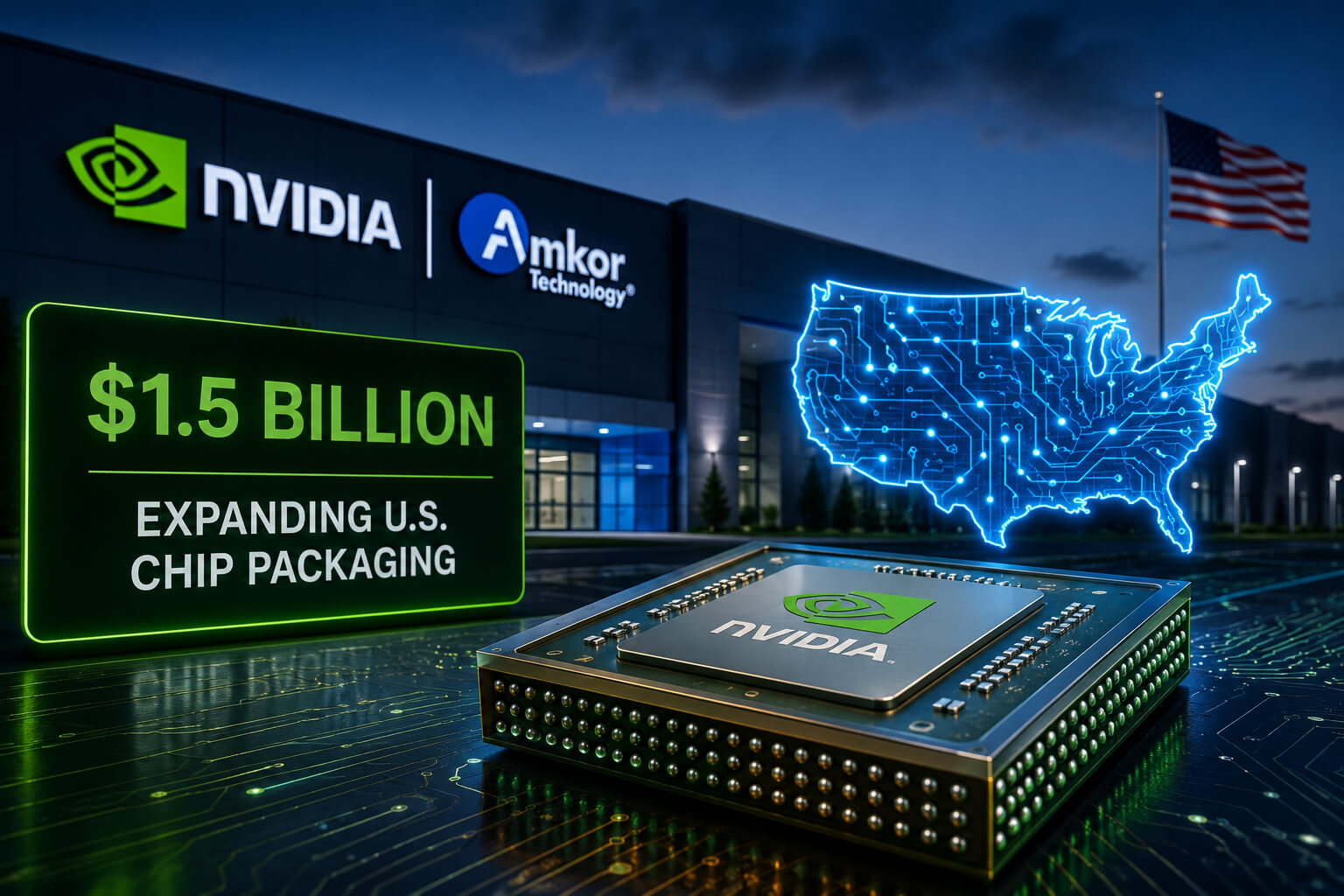
Nvidia is putting $1.5 billion behind a part of the semiconductor industry that rarely gets the same attention as graphics processors or fabrication plants.
The AI chipmaker has reached a multi-year agreement with Amkor Technology to develop advanced semiconductor packaging and testing technology in the United States. Nvidia will provide an upfront payment that will help Amkor expand its domestic capacity, according to the companies.
Amkor shares jumped around 17% in extended trading after the agreement was announced on July 23.
This is not simply another supplier contract. The deal targets one of the less glamorous, but increasingly difficult, parts of building powerful AI systems: connecting several complex pieces of silicon inside one usable package.
Nvidia Is Investing Beyond the AI Chip Itself
The Nvidia Amkor chip packaging deal covers the development of packaging and testing technologies for future AI and accelerated computing platforms.
Under the agreement, Nvidia will make a prepayment to support Amkor’s expansion in the US. Amkor did not provide a detailed schedule showing how the entire $1.5 billion will be spent, but the investment will support additional packaging capacity and joint technology development over several years.
That distinction matters.
Modern AI processors no longer operate as simple standalone chips. A high-end accelerator may combine computing dies, memory components and high-speed interconnects inside one package. Getting those pieces to work together affects performance, energy consumption and the number of finished systems manufacturers can actually ship.
The processor design may grab the headlines. Packaging can still decide how quickly it reaches a data centre.
Advanced Packaging Has Become an AI Infrastructure Bottleneck
Chip packaging once sounded like the final, relatively routine step of semiconductor manufacturing. AI has changed that.
Companies now need sophisticated techniques to place several chiplets and memory stacks extremely close together. These designs allow data to move faster while reducing some of the efficiency losses that come from sending information across a larger circuit board.
Nvidia’s data centre products depend heavily on this kind of integration. Demand for AI accelerators has also placed pressure on advanced packaging supply, making available capacity almost as important as access to leading-edge manufacturing.
Amkor Chief Executive Kevin Engel said the partnership reflects the central role packaging now plays in the development of AI infrastructure. Nvidia described Amkor’s global operations and US investment plans as important parts of creating a more resilient technology supply chain.
Amkor’s Arizona Expansion Sits at the Centre of the Agreement
The partnership will support Amkor’s growing advanced packaging presence in Arizona.
Amkor is developing a major packaging and testing campus in Peoria, placing the company close to the semiconductor manufacturing cluster forming around the state. The location is particularly useful because TSMC has been expanding chip production in the Phoenix area.
Keeping fabrication and packaging closer together could reduce the need to transport US-made wafers overseas for final assembly and testing.
That has been a weak point in America’s semiconductor strategy. Building more fabrication plants solves only part of the problem when advanced chips still need to leave the country before becoming finished products.
Amkor’s planned Arizona operation is expected to provide high-density packaging services for demanding processors used in AI and other high-performance computing systems. The company has positioned the site as a domestic link between wafer production and completed semiconductor products.
The Deal Gives Nvidia More Control Over Its Supply Chain
Nvidia has spent years dealing with demand that repeatedly tested the limits of its manufacturing network.
The company does not own the factories producing most of its processors. It relies on outside partners for wafer fabrication, memory, packaging, testing and system assembly. A delay at any one of those stages can restrict the number of AI accelerators reaching customers.
Paying Amkor in advance gives Nvidia a stronger position inside that chain. It helps create capacity that can be aligned with Nvidia’s future products rather than leaving the company to compete for whatever packaging supply becomes available.
It also reflects a wider shift in the semiconductor market. Large chip designers are increasingly committing money earlier, reserving manufacturing resources before the finished products arrive.
That can be expensive. Running short of capacity during an AI infrastructure boom would cost considerably more.
US Chip Manufacturing Needs More Than New Fabrication Plants
Washington has placed enormous attention on bringing advanced semiconductor manufacturing back to the United States. Fabrication plants remain an important part of that effort, but they cannot operate in isolation.
A chip still needs to be assembled, packaged and tested after it leaves the wafer production line. Much of that work currently happens in Asia, where suppliers have spent decades building deep expertise and large production networks.
The Nvidia-Amkor agreement will not suddenly make the US self-sufficient in advanced packaging. The scale of the Asian supply chain is far too large for that.
Still, it gives Nvidia a clearer domestic path for at least part of its future AI hardware production. For Amkor, the arrangement delivers both financial backing and a major customer as it expands its American operations.
The AI chip race is no longer only about who designs the fastest processor. It is becoming a contest over factories, memory, networking, electricity and now packaging capacity.
Nvidia appears determined to secure all of it before someone else does.
Sources
- Reuters: Nvidia, Amkor strike $1.5 billion chip packaging deal
- Amkor Technology: Strategic partnership with Nvidia
- Tom’s Hardware: Amkor begins work on Arizona advanced packaging campus