

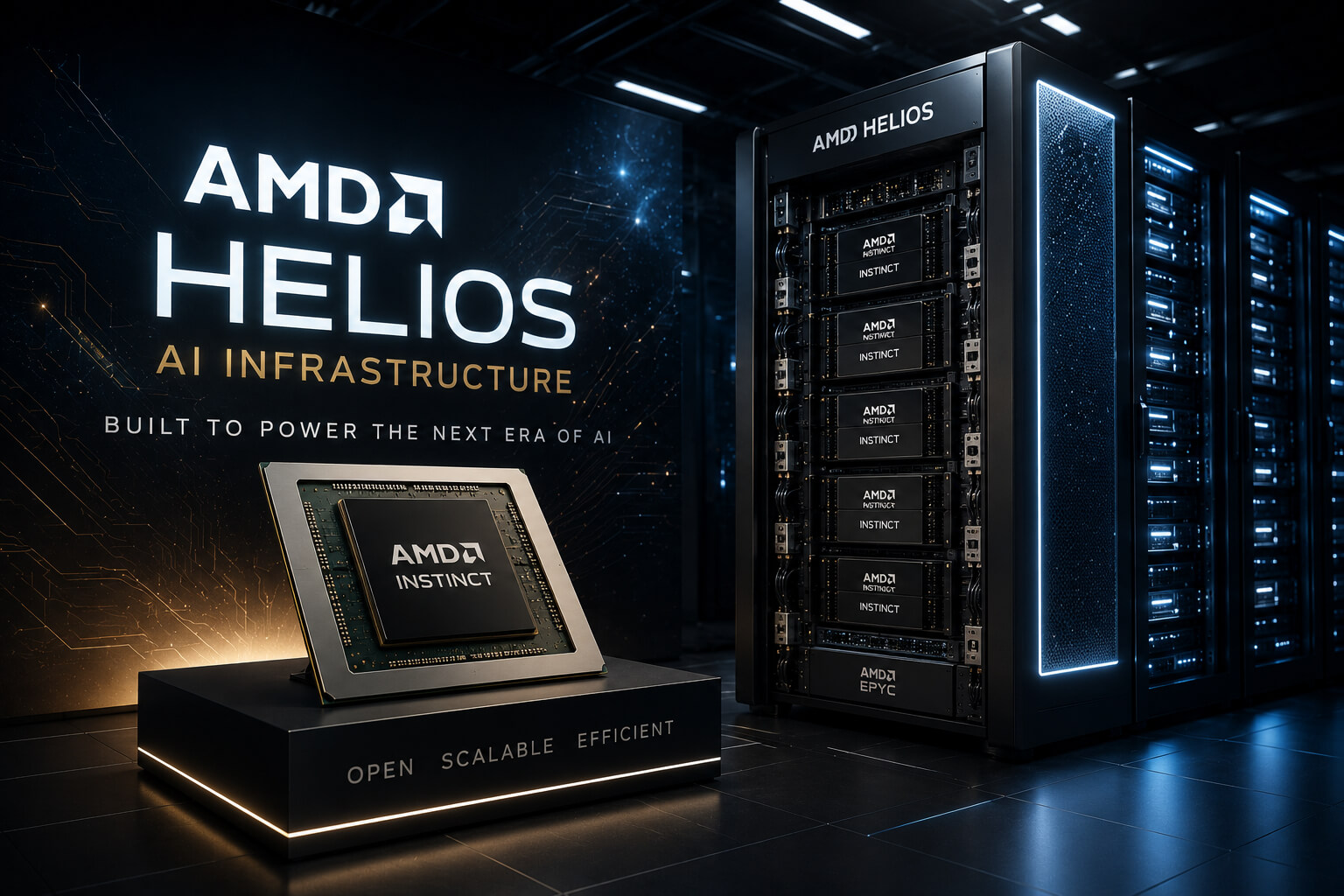
AMD is no longer trying to compete with Nvidia by selling one AI chip at a time.
The company has launched a broader AI infrastructure platform built around complete racks, high-performance processors, networking technology and software. It is a much bigger play, and AMD clearly wants customers to see it as an alternative to Nvidia’s tightly connected data centre systems.
AMD introduced the new portfolio during its Advancing AI 2026 event in San Francisco on July 23. At the centre of the announcement was Helios, AMD’s first rack-scale AI system and the company’s most direct attempt yet to challenge Nvidia inside large AI data centres.
AMD Helios Moves Beyond Individual AI Chips
Helios combines several parts of AMD’s data centre portfolio inside one integrated system.
Rather than asking cloud providers and AI companies to assemble processors, accelerators and networking components separately, AMD is packaging them together as a rack-scale platform. The system brings together AMD Instinct GPUs, EPYC server processors, Pensando networking technology and the company’s ROCm software platform.
That matters because the AI infrastructure market has changed.
Large customers are no longer comparing graphics processors in isolation. They want complete systems that can run enormous models, move data quickly between accelerators and keep power consumption under control.
Nvidia understood that shift early. Its success now comes from much more than GPUs. The company sells an interconnected combination of chips, networking equipment, server designs and software.
Helios gives AMD a clearer answer.
The company said the rack-scale systems are already in production and will support deployments by major AI companies operating at gigawatt scale.
AI Inference Is Becoming the Real Battleground
Much of the early AI hardware boom focused on training increasingly large models.
Now the pressure is moving toward inference—the computing work that happens after a model has been trained. Every chatbot response, AI-generated image or automated agent task requires inference capacity.
This can quickly become expensive when millions of users are making requests at the same time.
AMD sees that change as an opening.
Nvidia remains dominant in AI training infrastructure, but inference workloads may give customers more reason to look at alternative hardware. Cost, energy consumption, memory capacity and the number of tokens a system can generate all become difficult to ignore once an AI service reaches a large audience.
AMD designed Helios for this environment, including the growing use of AI agents that may complete multiple computing tasks for a single user request.
It is not the glamorous part of AI. It may be the part that determines whether AI products can operate profitably.
New Instinct GPUs Sit at the Centre of the Platform
AMD’s latest Instinct accelerators form the main computing layer inside Helios.
The company is positioning these processors for advanced model training, high-volume inference and agentic AI workloads. Helios also uses AMD’s EPYC server processors to manage orchestration, data preparation and the many general-purpose workloads running around the accelerators.
This combined approach allows AMD to argue that it can supply most of the essential computing technology inside an AI data centre.
The pitch is not simply that one AMD accelerator can beat one Nvidia GPU.
AMD wants customers to compare entire systems.
That includes performance per rack, memory capacity, networking speed, energy use and the total cost of generating AI responses. These measurements are becoming more important as companies move from experimental AI projects toward services used continuously by customers and employees.
AMD Is Leaning Into an Open AI Ecosystem
Software remains one of AMD’s hardest problems.
Nvidia’s CUDA platform has become deeply embedded across AI development. Researchers, developers and cloud providers have spent years building software around it. Moving those workloads to another hardware platform can require time, engineering work and money.
AMD has responded by pushing ROCm as a more open software environment while working directly with model developers and cloud providers.
The company’s wider message is fairly straightforward: customers should not have to depend on a single supplier for every layer of their AI infrastructure.
That argument may appeal to technology companies worried about hardware availability, pricing or long-term dependence on Nvidia. It does not automatically make migration easy, though. AMD still has to prove that its software tools can match the reliability and developer support customers already receive from Nvidia.
Hardware specifications alone will not settle this contest.
Cerebras Partnership Targets Faster AI Responses
AMD also announced a partnership with AI chip company Cerebras during the event.
The companies plan to connect AMD Helios systems with the Cerebras Wafer-Scale Engine in a disaggregated inference architecture. Under this model, different stages of an AI workload can run on the hardware best suited to each task.
AMD’s GPUs can handle high-throughput processing, while Cerebras hardware can focus on rapid token generation and low-latency responses.
Cerebras plans to use Helios systems in its data centres, with the combined infrastructure expected to become available through Cerebras Cloud.
It is an unusual partnership, but that may be the point.
Instead of insisting that every part of an AI workload must remain on AMD hardware, the company is showing that Helios can operate inside a more mixed computing environment.
Major Customers Could Give AMD More Credibility
AMD’s largest challenge has never been producing powerful silicon.
It is convincing major AI developers that the company can support massive, dependable deployments.
Microsoft has already announced plans to deploy AMD’s Helios platform through Azure. Other technology and AI companies are also expanding their use of AMD infrastructure as they look for additional sources of computing capacity.
These customer relationships give AMD more credibility than benchmark slides alone.
AI companies are consuming extraordinary amounts of computing power. Even businesses that prefer Nvidia may not want to rely entirely on one supplier, especially when infrastructure demand continues to rise.
AMD does not need to replace Nvidia across the whole market to build a substantial business. Capturing a meaningful share of new inference deployments would already represent a major shift.
Nvidia Still Holds the Stronger Position
None of this means Nvidia’s lead has disappeared.
The company remains the central supplier of AI accelerators and has spent years building an ecosystem around its hardware. CUDA, networking products and tightly integrated rack-scale platforms give Nvidia an advantage that AMD cannot erase through one product launch.
Customers also care about deployment experience. A system may look competitive on paper but still struggle if developers face software problems or if operators cannot scale it reliably.
AMD must prove that Helios works outside demonstration halls and controlled performance tests.
That will take real deployments, sustained availability and customers willing to discuss the results.
AMD Has Finally Made the Competition More Interesting
Helios changes the shape of AMD’s AI strategy.
The company is no longer presenting itself only as a cheaper or more available source of GPUs. It is offering an infrastructure architecture designed to sit at the centre of large AI data centres.
Nvidia remains ahead. Quite far ahead, in several areas.
Still, the market now has a more credible second option, and the timing could work in AMD’s favour. Demand for AI computing continues to grow, inference costs are becoming harder to hide and the largest technology companies do not want their expansion plans tied to a single chip supplier.
AMD has built the system. Now it has to show that customers can run it at scale.
Sources
- Reuters – AMD Expected to Launch Next Generation of AI Infrastructure to Challenge Nvidia
- AMD Newsroom – AMD Delivers Full-Stack Compute for the Agentic AI Era
- AMD – Advancing AI 2026
- AMD Newsroom – AMD and Cerebras Announce AI Inference Collaboration