

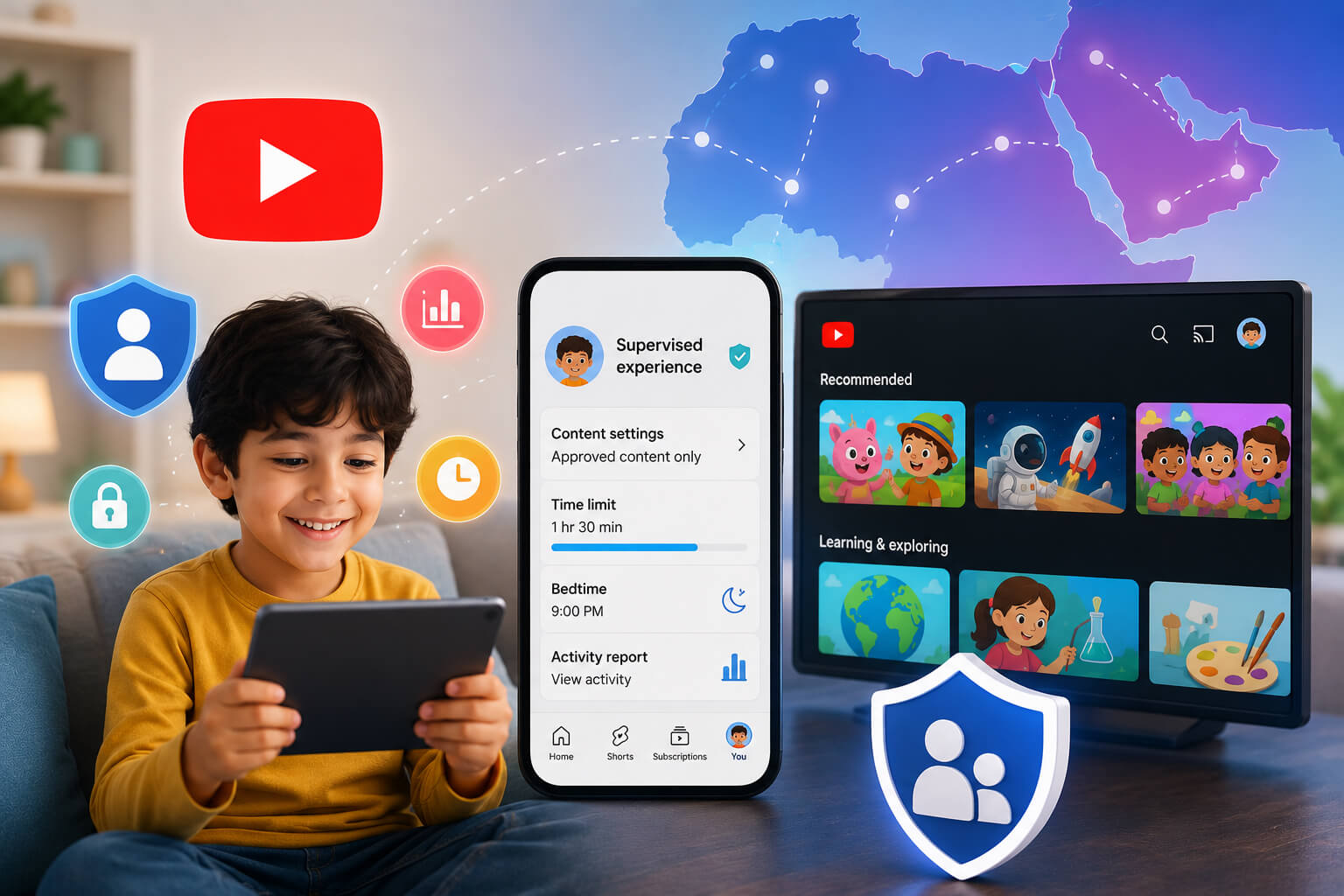
YouTube is giving families in the Middle East and North Africa a new way to manage how children use the platform.
The company has launched supervised kid accounts across MENA, including the UAE, as part of its wider push to build safer and more age-appropriate experiences for younger users. The rollout covers the Middle East, North Africa, and Türkiye, with tools that let parents control content settings, privacy, and time spent watching Shorts.
It is not exactly YouTube Kids. That is the important part.
This is for children who may have outgrown the more restricted YouTube Kids app but are still not ready to roam through the full YouTube experience without guardrails.
YouTube Wants a Middle Ground for Children Online
For years, parents have had a tricky choice.
Either keep children inside YouTube Kids, where the experience is more limited and heavily filtered, or allow them into the main YouTube app, where the content universe is much wider and harder to manage.
Supervised kid accounts are YouTube’s attempt to sit somewhere between those two options.
Children can use the main YouTube app, but under a parent-managed setup. Parents can choose content settings based on what they feel is appropriate, while YouTube adds extra protections around privacy, wellbeing, and recommendations.
That may sound like a small product update. It is not.
In MENA, where young people are deeply connected to online video, gaming, creators, learning content, and short-form entertainment, this kind of feature lands right in the middle of a bigger conversation: how much freedom should children have online, and who should control it?
Parents Can Set Up Accounts Through Family Center or Family Link
The supervised accounts can be set up through YouTube’s Family Center or through Google Family Link.
Once active, parents get access to controls that help shape a child’s YouTube experience. That includes choosing content levels, managing privacy settings, and using viewing-related tools that are designed to reduce unhealthy usage patterns.
YouTube is also adding Shorts timers, which matters because short-form video is where endless scrolling can become very easy, very fast.
Parents know this already.
A child opens one video, then another. Five minutes becomes 40 minutes. Suddenly the phone is still in their hand during dinner, homework, or bedtime. The timer feature is aimed at that exact behavior.
Why This Matters in MENA
The rollout comes at a time when governments, schools, and families across the region are paying closer attention to child safety online.
Digital platforms are no longer judged only by how much content they offer. They are also being judged by how they handle age-appropriate design, privacy, recommendations, and parental control.
That pressure is growing worldwide, but it feels especially relevant in markets where young users are spending more time on video platforms and social media apps.
YouTube’s supervised kid accounts give parents more tools, but they also show something else: platforms are trying to prove they can regulate younger user experiences before regulators force stricter rules on them.
A Safer YouTube, But Not a Perfect Fix
The new accounts should give families more control. That is the good part.
Still, parental controls are not magic. They do not replace conversations at home. They do not fully solve algorithmic recommendations. They do not guarantee that every video a child sees will match what a parent personally considers appropriate.
But they do create a better starting point.
Instead of handing over the full YouTube app with no structure, parents can now choose a more supervised version of the platform. For many families, especially those with children moving from YouTube Kids into older content habits, that middle ground may be exactly what was missing.
YouTube Is Trying to Grow Up With Its Young Users
The bigger story here is not just about one feature.
YouTube is trying to follow children as they grow. First, there is YouTube Kids. Then comes a supervised account. Later, a more open experience.
That staged approach makes sense. Children do not suddenly become ready for the full internet overnight. Families need steps, not switches.
With supervised kid accounts now rolling out across MENA, YouTube is making its pitch to parents: children can explore more, but not completely alone.
Whether families trust that pitch will depend on how well the controls actually work in daily use.
Because parents do not need another setting buried in an app.
They need something that helps.