

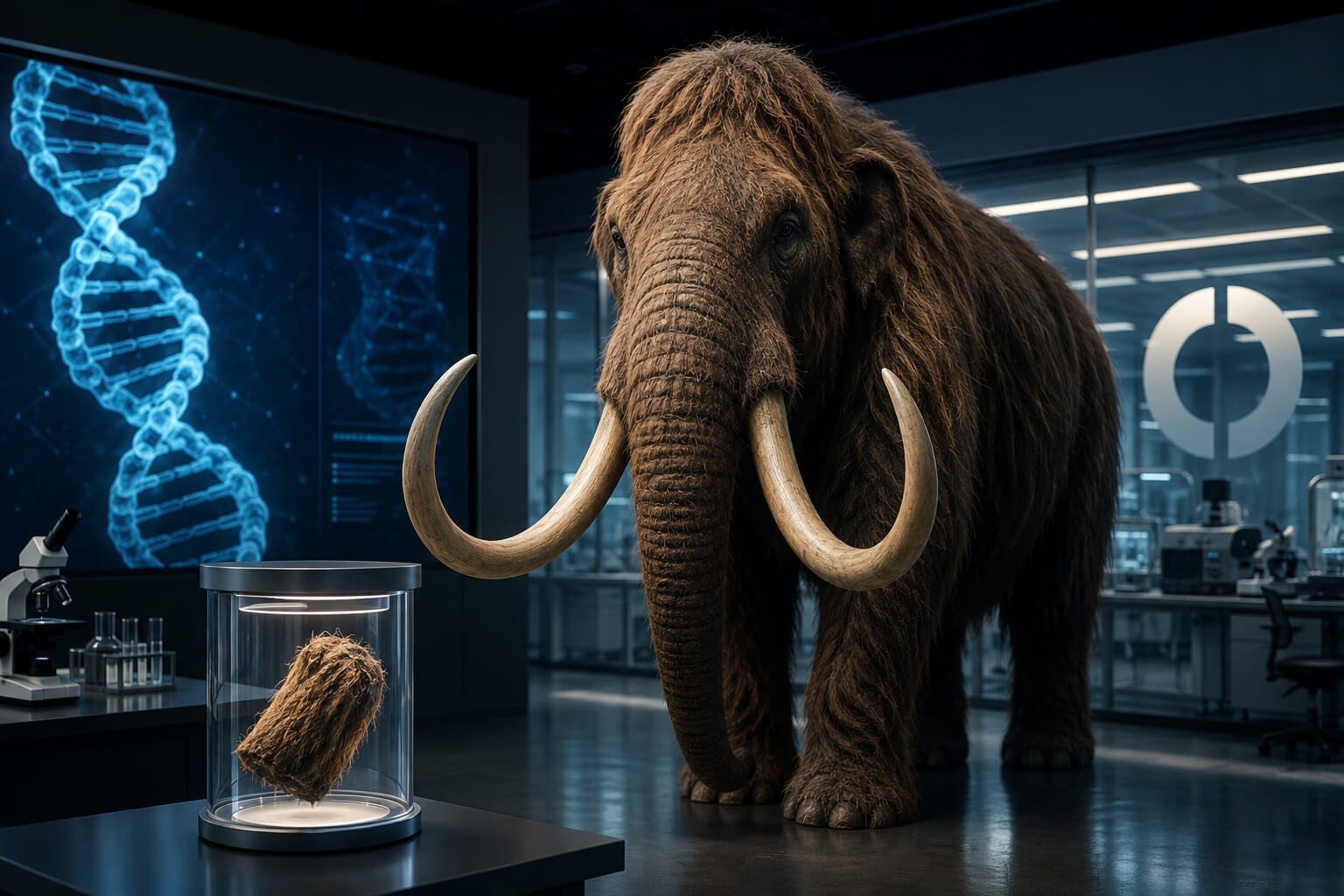
Colossal Biosciences may be preparing for another huge jump in valuation.
The Dallas-based biotechnology startup is reportedly holding discussions with investors about raising fresh capital at a valuation between $20 billion and $30 billion. The talks remain private, and neither the size of the potential investment nor the identity of the lead investor has been disclosed.
Nothing has been signed publicly. Still, the numbers being discussed are hard to ignore.
Colossal’s Valuation Could Double—or Triple
Colossal Biosciences was valued at approximately $10.2 billion during its previous major funding round. A deal at the upper end of the newly reported range would nearly triple that figure in roughly 16 months.
That is an unusually aggressive increase, even in a market that has become fascinated with ambitious biotechnology companies. Colossal isn’t building another software subscription or AI chatbot. Its scientists are working on genetic engineering, conservation tools and technology intended to recreate traits associated with extinct animals.
The company attracted global attention through its work involving the woolly mammoth, dodo and thylacine. Its most talked-about project, though, has been its attempt to recreate animals resembling the extinct dire wolf using ancient genetic material and edited cells.
The science has triggered plenty of debate. Investors appear interested anyway.
Revenue May Be Changing the Story
One detail makes this potential funding round more interesting: Colossal has reportedly started generating revenue.
The company has previously identified several possible business models beyond the headline-grabbing idea of de-extinction. These include licensing conservation technology, creating independent companies from internally developed research and eventually participating in biodiversity-credit markets.
Colossal has already supplied or offered conservation technology to government partners, including the United States and the United Arab Emirates. The UAE also reportedly invested $60 million in the company.
That gives Colossal a more practical commercial argument. The extinct animals bring attention, but the underlying genetic tools, reproductive systems and computational biology platforms may produce revenue much sooner.
Spin-Off Companies Are Adding Value
Colossal has also turned parts of its research operation into separate businesses.
Its spin-offs include Breaking, which develops technology for breaking down plastics, and Form Bio, a computational biology company that has raised outside funding. Another venture, Astromech, uses artificial intelligence and predictive modeling for biology and life-science applications.
Astromech was reportedly valued at $2 billion earlier in 2026.
This approach lets Colossal build companies around technologies that might otherwise remain buried inside a much larger research project. It also gives investors something more measurable than the distant possibility of returning extinct species to the wild.
Not everything needs to wait for a mammoth.
Artificial Wombs Could Become a Separate Business
Another potentially valuable piece of Colossal’s research is its artificial womb technology.
CEO and co-founder Ben Lamm has previously said the company plans to spin that work into a separate venture. While the system is being developed partly to support animal reproduction and conservation, the technology could eventually have applications in human fertility treatment.
Lamm has indicated that the technology could be ready as early as 2027. That timeline is ambitious, and any human medical use would face significant scientific, regulatory and ethical hurdles.
The commercial potential is obvious. So are the complications.
The Company Keeps Expanding Its Species List
Colossal’s project list has continued to grow while funding discussions reportedly move forward.
The company recently added the bluebuck antelope as its sixth target species. Its nonprofit conservation organization, the Colossal Foundation, has also partnered with the University of Tasmania on efforts to protect Tasmanian devils from contagious facial cancer.
These projects make Colossal harder to describe as simply a “de-extinction startup.” Much of its work now sits somewhere between conservation biology, gene editing, artificial intelligence and reproductive technology.
The dinosaurs are not coming back. That has never been the actual plan.
What Colossal is trying to build is a collection of technologies that can manipulate, preserve and potentially restore animal populations. Whether those tools justify a valuation approaching $30 billion is now the question investors may be trying to answer.
A New Deep-Tech Funding Boom
The reported talks arrive during renewed investor interest in deep technology, longevity research, advanced energy and biotechnology.
These companies require enormous amounts of capital. Their products can take years to become commercially useful, assuming they work at all. The payoff, however, can extend far beyond a single application.
Colossal fits that profile almost perfectly. Its best-known projects sound like science fiction, while its less glamorous technologies may become the real business.
The company has not publicly confirmed the fundraising discussions. Until a deal is announced, the $20 billion to $30 billion valuation remains a reported target—not a completed transaction.
Still, a valuation conversation at this scale says something by itself. Investors aren’t only betting on extinct animals. They are betting that the tools required to recreate them could become useful almost everywhere else in biology.
Sources
- TechCrunch: Colossal Biosciences reportedly in talks to raise new capital at $20B-$30B valuation
- Axios: Axios
- Colossal Biosciences: Official website
- WIRED: WIRED
- Business Wire: Business Wire
- University of Tasmania: University of Tasmania