

ASUS is stepping further into the AI PC race, and this time it is not only talking about faster chips or smarter laptops.
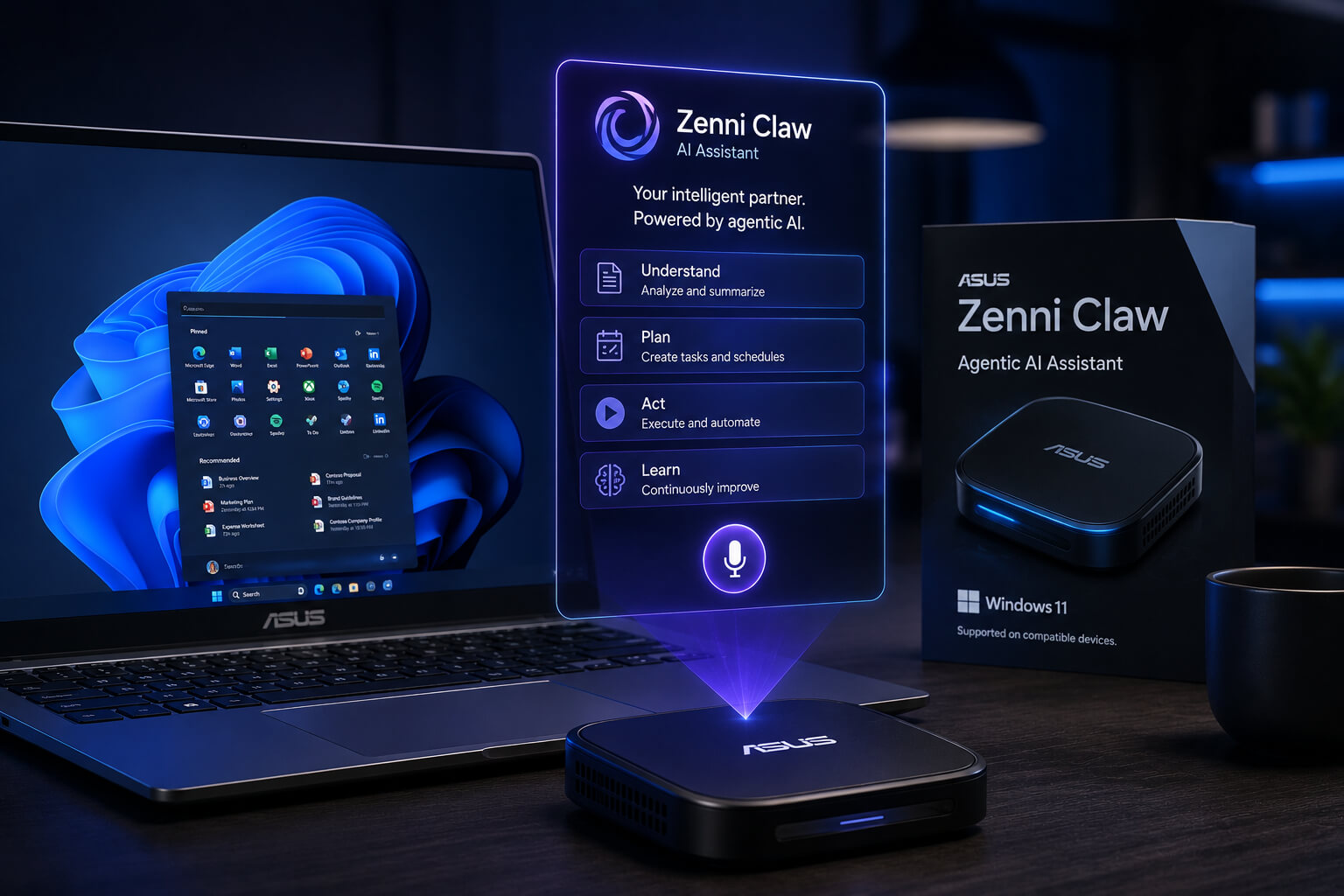
The company has launched ASUS Zenni Claw, a new agentic AI assistant built for supported ASUS devices running Windows 11. It is available as a free beta download and is designed to help users complete multi-step tasks through guided workflows instead of leaving them to figure out every prompt on their own.
That detail matters. A lot of AI tools still feel like blank boxes. You type something, hope the prompt is good enough, then clean up the result. Zenni Claw tries to make that process feel more structured.
ASUS Zenni Claw Is Built Around Guided AI Tasks
Zenni Claw is not being positioned as a normal chatbot. ASUS describes it as software that helps users start with guided skills, move through task-based flows, and review results before continuing to the next step.
In plain terms, ASUS wants the assistant to feel less like a conversation window and more like an AI helper with a plan.
The tool focuses on everyday tasks across areas such as work, travel, and daily planning. That could make it more approachable for users who are curious about agentic AI but do not want to build complex prompts from scratch.
This is probably the real point of Zenni Claw. ASUS is not just adding another AI label to a product page. It is trying to package agentic AI into something ordinary Windows users can actually open and try.
Free Beta Download for Supported ASUS Windows 11 Devices
ASUS Zenni Claw is available now as a free download for supported ASUS devices running Windows 11. The software is launching in beta, which means users should expect some limits, changes, and rough edges while ASUS continues improving the experience.
According to ASUS, the software needs Windows 11 64-bit, with 16GB of RAM and 20GB of available storage recommended. Some local AI model features may require higher system specifications.
That last part is important. Not every supported device will get the same experience. Devices that cannot run local AI features may still use Zenni Claw in Cloud-only mode.
So yes, it is free. But the best version of the experience may depend on the hardware inside the device.
Local and Cloud AI Work Together
One of the more interesting parts of Zenni Claw is its hybrid AI setup.
ASUS says the assistant can work with both cloud AI providers and on-device local models. Users can manage those options through the Models page, monitor token usage, and configure Auto-Routing between cloud and local engines.
That sounds technical, but the idea is simple enough. Some tasks may run locally on the device. Others may be sent to cloud AI models, depending on what the system can handle and how the user configures it.
For ASUS, this gives Zenni Claw a way to sit between the AI PC hardware trend and the wider cloud AI ecosystem. It does not have to choose one side completely.
ASUS Wants to Make Agentic AI Less Intimidating
Agentic AI has become one of those tech phrases that sounds bigger than it needs to be. At its simplest, it refers to AI tools that can follow steps, use workflows, and help complete tasks with less constant hand-holding.
Zenni Claw appears to be ASUS’ attempt to make that idea feel less abstract.
Instead of asking users to understand agents, models, routing, and prompt chains, ASUS is giving them prebuilt skills and guided flows. That could help beginners experiment without getting lost immediately.
It also gives ASUS a software layer for its AI PC lineup. The company is no longer relying only on specs, processors, and battery claims. It now wants its laptops and desktops to offer a more visible AI experience.
The AI PC Race Is Becoming a Software Race Too
For months, the AI PC conversation has mostly focused on hardware. NPUs. Local models. More memory. Better efficiency. All useful, sure.
But Zenni Claw shows the next problem: people need actual reasons to use AI features on their PCs.
A powerful AI laptop does not mean much if the user never opens the AI tools. ASUS seems to understand that. By offering Zenni Claw as a free beta, the company can test how users respond to agentic workflows while improving the product over time.
It is still early. Beta software can be messy. Feature availability may vary. Some users may find the guided assistant useful, while others may continue using their usual AI tools.
Still, ASUS is making a clear move here. The AI PC battle is no longer just about who has the strongest hardware. It is also about who can make AI feel useful enough to become part of everyday computer work.
Sources
- ASUS Zenni Claw official page: https://www.asus.com/content/asus-zenni-claw/
- JAM Online report: https://jamonline.ph/tech-news/asus-launches-zenni-claw-ai-assistant-for-supported-windows-devices/
- ASUS Zenni Claw installation and user guide: https://www.asus.com/ph/support/faq/1057081/
- Digital Journal / GlobeNewswire availability report: https://www.digitaljournal.com/pr/news/globenewswire/asus-zenni-claw-available-making-1156896657.html