

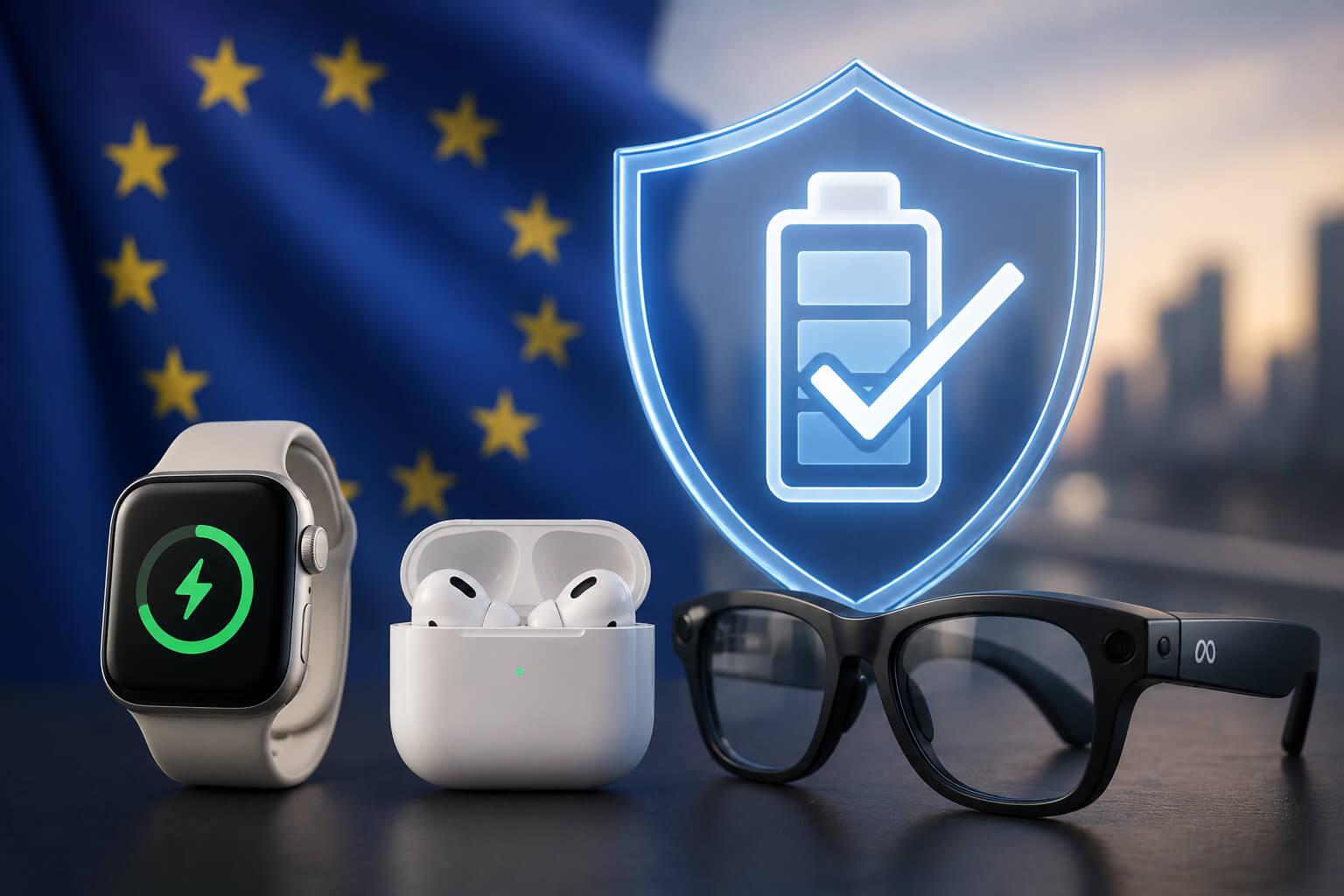
Apple Watch, AirPods, and Meta smart glasses may have just avoided one of the most awkward design problems coming from Europe.
The European Union has been pushing harder on repairability, waste reduction, and longer-lasting gadgets. One big part of that plan is the requirement for portable batteries in many products to be removable and replaceable by consumers. Sounds simple when talking about a TV remote. Less simple when talking about tiny earbuds, sealed smartwatches, fitness trackers, or smart glasses sitting on someone’s face all day.
Now, the European Commission is proposing extra exemptions that could give wearable devices more breathing room. That means products like Apple Watch, AirPods, and smart glasses may not need to be redesigned for direct consumer battery replacement in the same way larger portable electronics might be.
EU Battery Rules Were Starting to Look Like a Problem for Wearables
The EU’s battery regulation is built around a reasonable idea: people should not have to throw away an entire device just because the battery dies.
That is the good part.
The messy part is product design. Many modern wearables are small, sealed, waterproof, sweat-resistant, and packed with sensors. Open them too easily and you may ruin the thing the device was built to survive. Water. Dust. Drops. Sweat. Daily abuse.
The European Commission has acknowledged that some products need different treatment. Its proposed exemptions include wearable devices such as smartwatches and fitness trackers, along with electric toys and certain industrial equipment.
This does not mean companies can ignore battery repair completely. Not exactly.
Apple Watch and AirPods May Still Need Professional Battery Access
The key detail here is the word “partial.”
According to legal analysis from Cooley, the proposed exemptions would allow battery removal and replacement by independent professional repairers instead of requiring end users to do it themselves. That is a big difference. It protects the repairability goal, at least on paper, while avoiding a situation where every wearable must be built like an old phone with a pop-off back cover.
For Apple, that matters.
Apple Watch models are built around tight sealing, compact internals, and water resistance. AirPods are even harder. Their batteries are tiny, glued inside small shells, and notoriously difficult to replace in a normal repair setting. Forcing true user-replaceable batteries into that kind of design could change the size, durability, and feel of the products.
Maybe Apple could engineer around it. Apple usually can.
But would users want thicker AirPods just so the battery can be swapped at home? That question is not as simple as right-to-repair debates sometimes make it sound.
Meta Smart Glasses Also Benefit From the Proposed Exemption
Meta has its own reason to watch this closely.
Smart glasses are already fighting a difficult design battle. They need batteries, cameras, microphones, speakers, chips, wireless connectivity, and sometimes displays, all inside something that still has to look like glasses. Add a strict consumer-removable battery rule and the product gets even harder to build.
Reports earlier this year said Meta’s rollout of display-equipped Ray-Ban smart glasses in Europe had been complicated by battery rules, AI regulation, and supply issues.
This proposed exemption could remove at least one headache.
Not all of them. Just one.
This Is Really About Repairability Versus Miniaturization
The bigger story is not only Apple, Meta, or AirPods.
It is the collision between two tech trends.
Consumers want smaller devices. Thinner watches. Lighter earbuds. Smarter glasses that do not look ridiculous. Companies want sealed designs because sealed designs are easier to make durable, premium, and water resistant.
Regulators want longer product life, less electronic waste, and easier repair.
Both sides have a point.
A replaceable battery rule makes obvious sense for many devices. For wearables, it gets trickier. A smartwatch is not a laptop. A wireless earbud is not a power bank. Smart glasses are not a kitchen appliance.
That is why the EU appears to be carving out a more flexible path.
The Rule Still Pushes Tech Companies Toward Better Repair
This reprieve should not be mistaken for a free pass.
The European Commission says portable batteries in products sold in the EU must generally be removable and replaceable by consumers, with exemptions mainly shaped around safety, technical limits, and product design realities. The goal remains longer product life and better recycling.
So Apple, Meta, and other wearable makers may avoid full consumer battery replacement rules, but pressure is still building.
Battery service has to improve. Repair networks will matter more. Independent professional repairers may get a stronger role. Product makers will have to explain why some devices cannot be opened by regular users.
That is probably where the real fight moves next.
Not whether batteries should be replaceable. Most people agree they should be.
The argument is now about who gets to replace them, how difficult it should be, and whether companies can keep using sleek sealed designs while still claiming they support repairability.
Why This Matters
For consumers, this could mean future Apple Watch, AirPods, and smart glasses designs stay familiar. No bulky battery doors. No strange redesign just to satisfy a strict interpretation of the law.
For repair advocates, it may feel like a compromise that does not go far enough.
For tech companies, it is a relief. A practical one.
The EU is still changing the rules of consumer electronics. That part has not changed. But with wearables, regulators seem to be admitting something obvious: tiny devices need different rules than bigger gadgets.
And honestly, that makes sense.
A repairable future is good. A repairable future that ignores product reality? That gets messy fast.
Sources
- AppleInsider: Apple Watch, Meta Glasses and AirPods get reprieve from EU replaceable battery law
- European Commission: Commission seeks views on battery removability exemptions
- Cooley Productwise: EU Batteries Regulation exemptions
- FashionNetwork: Meta glasses withheld from EU over battery rules and supply issues