

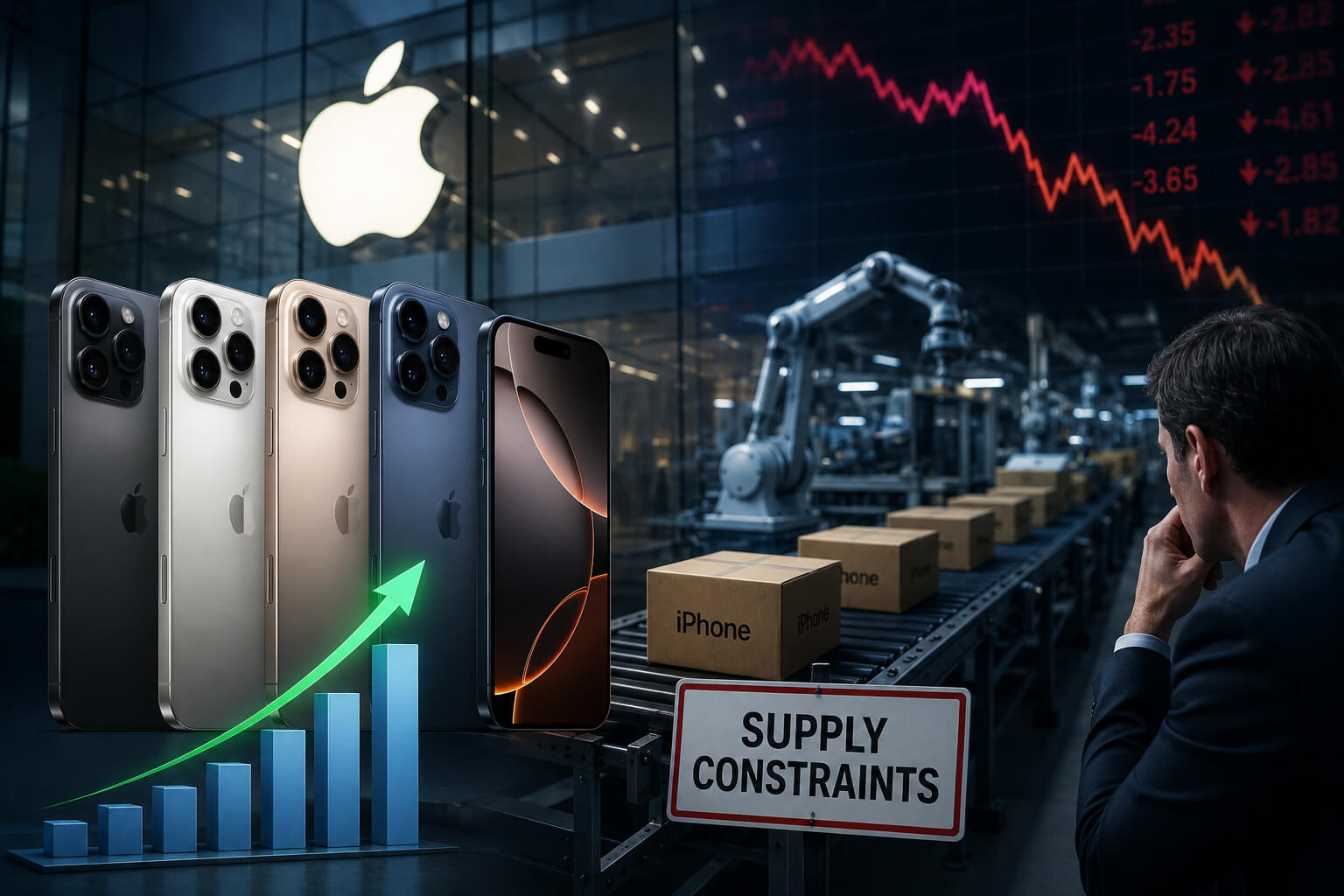
Apple delivered one of its strongest iPhone quarters in years. Investors still hit the sell button.
The technology giant reported record June-quarter iPhone revenue, but its latest guidance shifted attention away from impressive sales and toward a growing problem: it simply cannot secure enough advanced components to keep up with demand. Shares fell sharply after management warned that supply shortages would weigh on growth over the coming months.
Strong iPhone Demand Is No Longer Apple’s Biggest Challenge
On paper, Apple’s results looked healthy.
iPhone revenue climbed to $54.25 billion, marking the company’s strongest June quarter ever and comfortably beating Wall Street expectations. Demand for both iPhones and Macs surprised Apple itself, suggesting customers are still willing to upgrade despite economic uncertainty.
That wasn’t the issue.
CEO Tim Cook explained that Apple’s forecasts are now being limited by manufacturing capacity rather than customer interest. Advanced chip production and memory supplies have become increasingly difficult to secure as AI infrastructure spending consumes more of the global semiconductor supply chain.
AI Is Reshaping the Semiconductor Supply Chain
Artificial intelligence is affecting far more than software.
Technology companies continue investing billions in AI data centres, creating intense competition for advanced chips and memory. Those same components power Apple’s iPhones, Macs and iPads. As demand rises across the industry, prices have climbed while supply has tightened.
Apple acknowledged that higher memory costs and limited access to cutting-edge manufacturing capacity are expected to reduce flexibility throughout the current quarter. Instead of struggling to attract buyers, the company is struggling to build enough products.
Investors Focus on Apple’s Outlook Instead of Its Results
Markets usually reward strong earnings.
This time they focused on what comes next.
Apple forecast revenue growth of 9% to 11% for the current quarter, below analysts’ expectations of roughly 12%. While the difference may appear modest, it raised fresh concerns that supply bottlenecks could delay shipments during one of Apple’s most important product launch periods.
The market reaction was swift. Apple shares dropped more than 7% in pre-market trading, putting hundreds of billions of dollars in market value at risk as investors reassessed near-term growth expectations.
Can Apple Raise iPhone Prices Without Hurting Demand?
Another question now hangs over Apple’s next iPhone launch.
Many analysts expect Apple to increase iPhone prices later this year to offset rising manufacturing costs. The challenge will be finding the right balance between protecting profit margins and maintaining the strong upgrade cycle that has driven recent sales.
Several analysts believe Apple still has room to raise prices, especially with new AI-powered Siri features, future hardware upgrades, and financing programmes encouraging customers to replace older devices more frequently. Even so, pricing remains one of the biggest unknowns heading into the next iPhone generation.
Apple’s Supply Chain Faces a New Reality
For years, Apple built its reputation on supply chain excellence.
Today’s challenge looks different. Demand isn’t fading. Manufacturing capacity is becoming the bottleneck.
As AI companies compete aggressively for the same advanced chips and memory that power consumer devices, Apple must navigate an increasingly crowded supply chain while preparing for its next major product launches. If component availability improves, today’s delayed sales could simply shift into future quarters. If shortages continue, Apple’s growth story may depend as much on suppliers as on customers.