

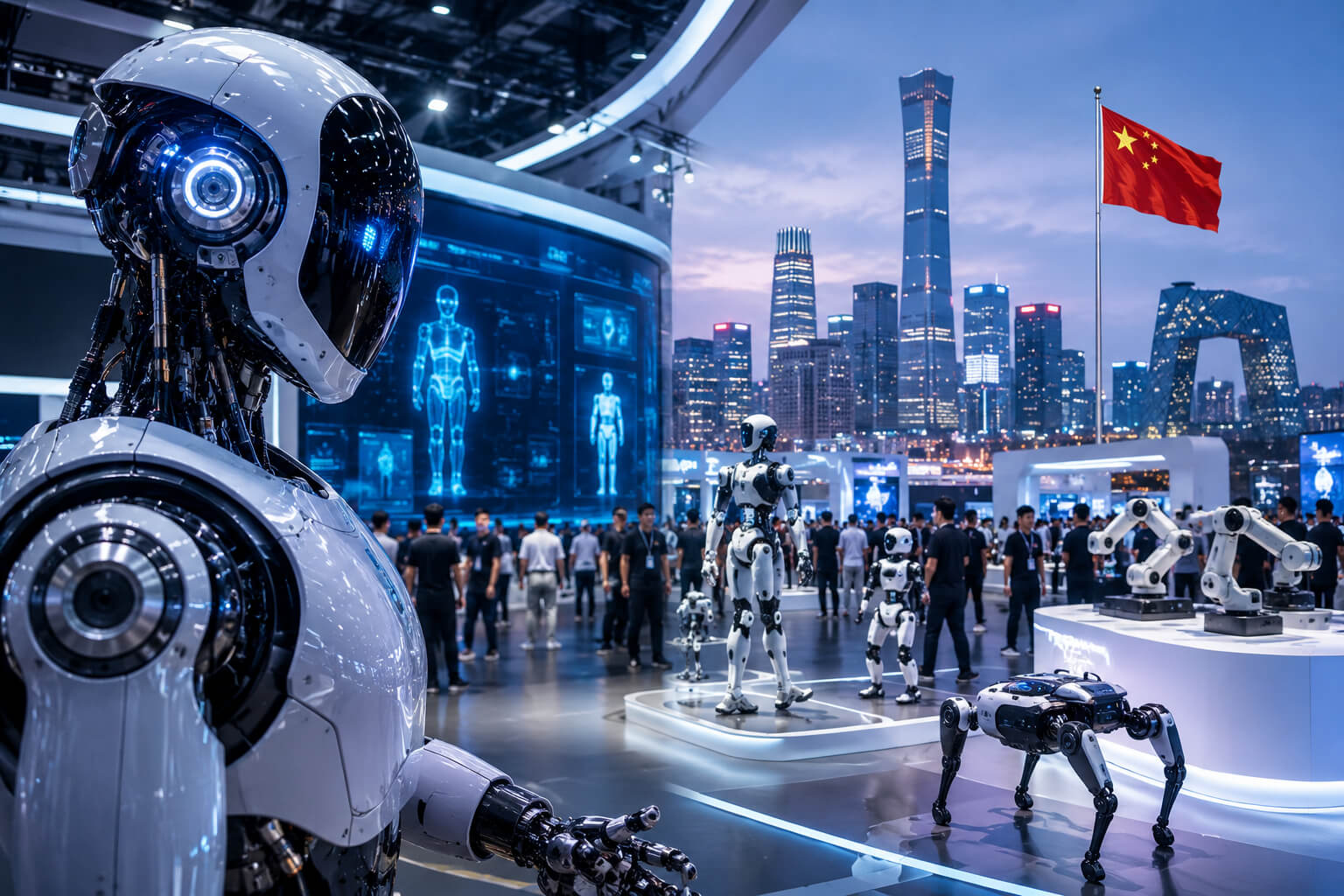
China’s robotics industry has spent years proving that its machines can walk, run, dance and occasionally steal the show. Now comes the harder part: getting people and businesses to actually use them.
That shift was hard to miss at the 2026 World Robot Conference in Beijing, where Chinese robot makers arrived with an increasingly commercial message. The machines still attracted crowds. But the conversation around them has changed.
Less “look what this robot can do.”
More “who is going to buy it?”
Beijing Robot Show Puts Commercial Use in the Spotlight
The World Robot Conference opened in Beijing on August 19 and runs through August 23, bringing together hundreds of robotics companies and thousands of products.
Organizers said more than 300 companies were expected to participate, with over 2,000 exhibits and more than 150 new product launches.
That scale tells its own story. China is no longer treating humanoid robotics as a small research experiment.
Manufacturers are trying to build an industry around it.
Factories are one obvious target. Warehouses are another. Retail, healthcare, hospitality and home assistance are all being tested as companies search for jobs where robots can provide something more useful than a viral video.
And that is where things get complicated.
Humanoid Robots Have Become Impressive. Useful Is Harder.
A humanoid robot performing on a stage is working inside a carefully controlled environment. Put the same machine in a home, hotel or factory and the problem changes fast.
Objects move. People get in the way. Floors are uneven. Tasks rarely happen exactly as expected.
Folding clothes sounds mundane until a robot has to recognize different fabrics, grab the right edge, adjust its grip and recover when the shirt slips.
That kind of boring reliability is exactly what the industry needs.
China’s robot makers have become remarkably good at producing capable hardware at falling prices. The next contest is intelligence, dexterity and consistency.
A robot that completes a task nine times out of ten may look impressive in a demonstration.
A factory manager may still hate it.
The challenge is similar to the wider push toward physical AI systems operating reliably in real-world environments, where impressive demos matter much less than consistent performance around ordinary people.
China Has a Manufacturing Advantage
China enters this race with something difficult for competitors to copy quickly: an enormous manufacturing ecosystem.
Motors, actuators, batteries, sensors, precision components and electronics suppliers already operate at scale across the country. Much of that industrial capacity was built around automobiles, consumer electronics and other manufacturing sectors. Robotics can tap into the same network.
China has also been the world’s largest industrial robot market for years.
According to information released ahead of the conference, domestic Chinese brands now represent more than half of China’s industrial robot market. The country has also built a broad humanoid robot supply chain covering components, complete machines, software and data services.
That does not guarantee a winning humanoid robot.
It does make experimentation cheaper.
Companies can build another version, change a component, test a different hand or reduce the selling price without recreating an entire supply chain from scratch.
The Price War Could Matter More Than the Robot Tricks
Robotics demonstrations tend to focus on what machines can physically do.
Commercial adoption tends to focus on a less exciting number: cost.
Chinese companies have been aggressively pushing robot prices lower, creating competition that looks increasingly familiar to anyone who watched the country’s electric vehicle industry develop.
Once several manufacturers start chasing the same market, impressive hardware alone stops being enough. Pricing, maintenance, software, reliability and production capacity begin to matter.
That may ultimately determine which companies survive.
The robot with the best backflip is not necessarily the robot a factory will order by the thousand.
Beijing Is Trying to Create Places for Robots to Actually Work
The conference itself reflects that change.
For the first time, organizers introduced a robot shopping street, where visitors can interact with robots performing consumer-facing jobs, including food and service applications.
There is also a broader push toward application testing.
The conference’s Global Robotics Application Exploration Program is intended to match mass-produced robots with development teams that can test them in different real-world scenarios.
That approach matters because robot makers desperately need data from environments that are messy, unpredictable and full of humans.
You cannot learn everything in a laboratory.
Sometimes the robot needs to encounter the chair somebody left in the wrong place.
Public events are increasingly becoming testbeds for these systems too. In Dubai, for example, an autonomous robot has been used to distribute water and present medals during a community race, showing how robotics can move into ordinary public settings long before general-purpose humanoids become commonplace.
China Wants Its Robotics Moment
The ambition goes beyond selling a few thousand humanoids.
Artificial intelligence has already transformed software. Robotics companies are betting that the next major shift will happen when AI moves into physical machines capable of navigating and manipulating the real world.
China clearly wants a large piece of that market.
The country accounted for roughly 90% of global humanoid robot shipments in 2025, according to figures cited by Chinese conference organizers, with more than 330 humanoid models already developed.
Forecasts remain aggressive too. IDC expects global humanoid robot shipments to exceed 510,000 units by 2030.
Forecasts this early should be treated carefully. Robotics history is packed with machines that were supposedly five years away from changing everything.
Still, production is rising. Prices are falling. Investment keeps arriving.
Something is happening.
Mass Adoption Still Depends on Boring Things
There probably will not be one dramatic moment when humanoid robots suddenly become normal.
Adoption is more likely to happen quietly.
- A warehouse orders twenty.
- An electronics factory orders fifty.
- A hotel tries three.
One company discovers that a robot can perform a repetitive task cheaply enough and reliably enough to make the numbers work. Competitors notice. Orders grow.
That is a very different path from the science-fiction idea of millions of general-purpose robots suddenly appearing inside homes.
For now, China’s robot makers appear focused on finding those first repeatable jobs.
The machines walking around Beijing this week are still demonstrations of engineering.
The more important question is whether they can become products people keep using after the crowd goes home.
Sources
- Reuters — China robot makers flock to Beijing show, seek path to mass adoption
- Beijing Municipal Government — World Robot Conference 2026 event details
- Associated Press — Coverage of robots and commercial applications displayed at the 2026 World Robot Conference
- IDC — Humanoid robotics commercialization and projected global shipment growth