

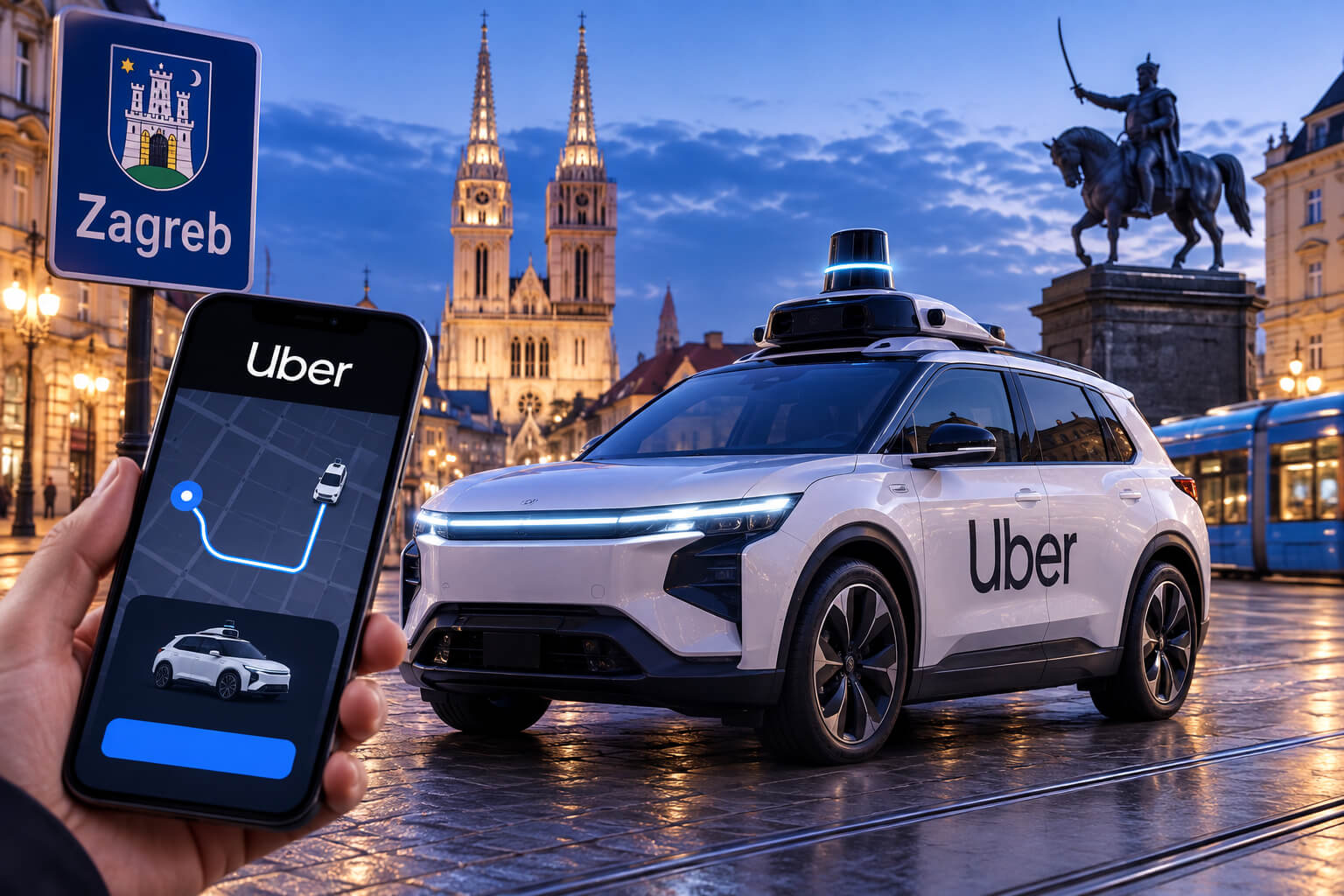
Uber’s robotaxi push has officially reached Europe.
The ride-hailing company has launched autonomous rides through its app in Zagreb, Croatia, giving customers in the city access to self-driving vehicles developed with Chinese autonomous driving company Pony.ai and Croatian mobility company Verne.
The launch on August 19 marks the first time Uber users in Europe can book an autonomous vehicle directly through the Uber app. It is a fairly small rollout for now. Still, Zagreb suddenly finds itself at the front of a much bigger race over who gets robotaxis onto European streets first.
And there is one important detail: these cars are not yet running completely alone.
Uber Autonomous Rides Are Now Available in Parts of Zagreb
Riders can book an autonomous trip through Uber within selected areas of Zagreb, including parts of the city center.
The service operates between 7 a.m. and 9 p.m., with Uber saying both operating hours and geographic coverage are expected to expand over time.
For now, a licensed operator remains inside the vehicle and sits behind the wheel to monitor the system. The companies describe this as part of a phased rollout before eventually moving toward fully driverless operations.
That makes the launch less dramatic than an empty robotaxi pulling up at the curb. Technically, though, the shift matters. Europeans no longer have to use a separate experimental platform to experience the service in Zagreb. It is being folded into an app millions of people already understand.
Pony.ai Provides the Self-Driving Technology
The autonomous driving system comes from Pony.ai, one of the increasingly visible Chinese companies trying to take robotaxi technology beyond China.
The Zagreb fleet uses Pony.ai’s Gen-7 autonomous driving system on Arcfox Alpha T5 Robotaxi vehicles. The cars had already been undergoing public-road testing in Zagreb months before Uber switched on autonomous bookings inside its own app.
The partnership splits the job between three companies.
Pony.ai supplies the autonomous driving technology. Verne owns and operates the fleet and handles the local service infrastructure. Uber brings the booking, payments, customer service and, most importantly, its existing ride-hailing network.
Rather than building everything itself, Uber is becoming the layer connecting riders with autonomous vehicle companies.
That appears to be the strategy now.
Zagreb Was Already Testing Commercial Robotaxis
The arrival of Uber bookings is actually the next chapter of a rollout that started earlier this year.
Verne launched commercial Pony.ai-powered robotaxi rides in Zagreb on April 8, initially allowing passengers to book and pay through the Verne app. Uber integration was promised at the time but had not yet gone live.
Now it has.
Zagreb therefore occupies a strange position in Europe’s autonomous vehicle market. It is not London, Paris or Berlin leading this particular experiment. It is Croatia’s capital, where regulators and companies have moved quickly enough to put paying passengers inside autonomous vehicles while much of Europe is still preparing frameworks for larger deployments.
The initial fleet remains limited, and the presence of an onboard operator makes clear that this is still an early stage.
But it is commercial. People can open Uber, request a ride and potentially get an autonomous car.
That line has now been crossed.
Uber and Pony.ai Have Much Bigger Plans for Europe
Zagreb probably will not remain an isolated test for long.
Just days before the Uber app launch, Pony.ai announced an expanded partnership with Uber targeting more than 2,000 robotaxis across five European cities.
The companies have not yet revealed all of those cities. They have said the expansion will build on what they are already doing in Zagreb and could eventually extend into the Middle East as well.
Uber has been assembling autonomous vehicle partnerships at an unusually aggressive pace. Instead of betting on a single self-driving company, it has deals spanning companies including Pony.ai, Wayve, WeRide, Momenta, Motional, Nuro and others.
That same multi-partner strategy is already visible in Dubai’s growing robotaxi ecosystem, where Uber is working alongside autonomous driving companies including Baidu and WeRide as commercial driverless services expand.
The logic is becoming clearer. Uber does not necessarily need to win the race to build the best autonomous driving system. It wants to be the app people use when those systems are ready.
Zagreb is a glimpse of what that could look like.
Robotaxis Are Moving From Demos to Everyday Apps
For years, European robotaxis have mostly existed as announcements, closed tests, demonstrations or promises about what would arrive next.
Putting autonomous vehicles inside Uber changes the experience in a subtle way. Robotaxis stop feeling like a separate technology product and start looking like another transportation option sitting alongside UberX and other familiar ride categories.
There are still obvious questions. How quickly can the onboard operator be removed? How will the vehicles perform as service areas get larger? What happens when fleets grow from a handful of vehicles into hundreds or thousands?
Regulators will be watching those answers closely.
Zagreb does not prove that driverless taxis are ready to take over European cities. It does show that the technology has moved beyond another carefully staged prototype.
The robotaxi is now showing up inside the ride-hailing app.
For Uber, that may be the more important milestone.
Sources
- Reuters — Uber launches autonomous rides in Zagreb, its first in Europe
- Uber Technologies — Verne, Pony.ai and Uber partnership announcement
- Verne — Europe’s first commercial robotaxi service launches in Zagreb
- Pony.ai — Expanded European robotaxi partnership with Uber