

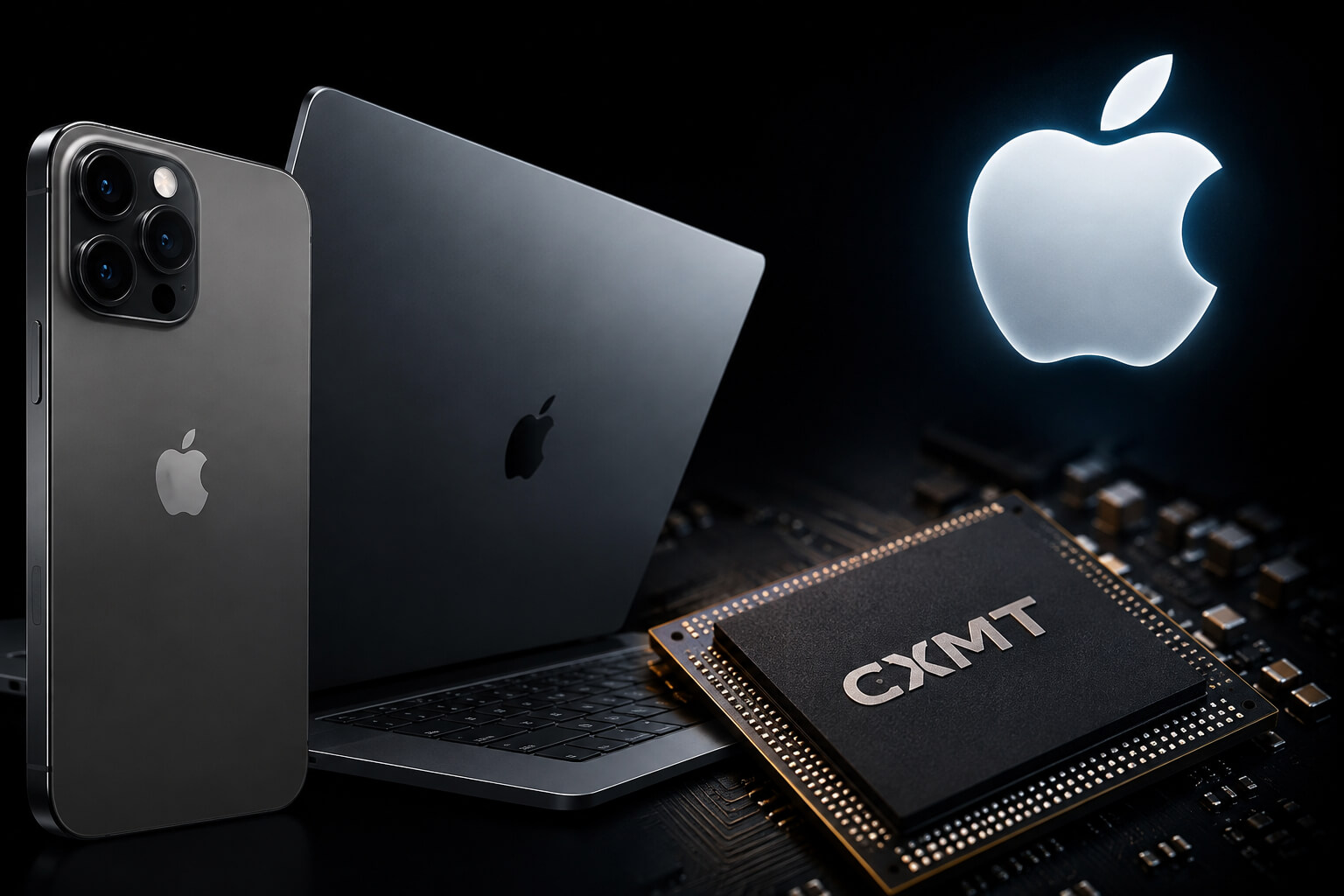
Apple is reportedly testing memory chips made by Chinese semiconductor company ChangXin Memory Technologies, better known as CXMT, as pressure builds across the global memory market.
The testing could eventually open another supply option for iPhones and MacBooks, particularly devices sold in China. Nothing is settled yet. Apple has not committed to putting CXMT chips into commercial products, and political restrictions surrounding Chinese semiconductor companies make this a much more complicated supplier decision than simply finding cheaper RAM.
The bigger issue is supply.
Memory has suddenly become one of the uncomfortable pressure points in the technology industry, with AI infrastructure consuming enormous amounts of advanced memory while traditional electronics companies compete for what’s left.
Apple Looks Beyond Its Usual Memory Suppliers
Apple has traditionally relied on major memory manufacturers including Samsung Electronics, SK Hynix and Micron.
CXMT would be a very different addition.
The Chinese company has grown quickly in the DRAM market and is increasingly being treated as a serious competitor rather than a domestic alternative operating several generations behind established manufacturers.
Apple has reportedly been evaluating CXMT’s DRAM through technical qualification testing. That’s an important distinction. Testing a supplier doesn’t mean Apple has placed an order, but qualification is normally required before components can enter Apple’s production supply chain.
Earlier reports also linked Apple with discussions involving Chinese memory producer Yangtze Memory Technologies, or YMTC.
Apple appears to be keeping several doors open.
The AI Boom Is Squeezing Memory Supply
This isn’t happening in a vacuum.
The massive expansion of artificial intelligence data centers has changed the economics of memory manufacturing. Semiconductor companies have strong incentives to prioritize high-margin products used in AI servers, including high-bandwidth memory.
Consumer electronics manufacturers still need huge quantities of conventional memory.
So does Apple.
That creates a fairly straightforward problem: iPhones, Macs, iPads and other devices can’t ship without memory, no matter how advanced Apple’s processors become.
Recent reports have pointed to increasingly tight DRAM availability across the industry. Apple CEO Tim Cook has also publicly discussed unusually high memory costs after the company raised prices on some products.
Finding another large supplier starts looking less optional under those conditions.
CXMT Has Become Harder to Ignore
CXMT’s rise is one of the more interesting parts of the story.
The company has expanded from a heavily supported Chinese semiconductor manufacturer into one of the world’s largest DRAM producers. Previous reports estimated that CXMT accounted for roughly 11% of global DRAM wafer capacity in 2025, with further production expansion planned.
That’s enough capacity to get the attention of companies that buy memory by the millions of units.
Apple isn’t alone either. Other global computer manufacturers have reportedly explored or already used CXMT components in products sold outside the United States as memory supply tightens.
CXMT therefore represents something Apple rarely dislikes having: leverage.
Even if Apple never becomes a major CXMT customer, another technically acceptable supplier could strengthen its position when negotiating prices and capacity with Samsung, SK Hynix and Micron.
Washington Could Be the Bigger Problem
Qualifying the chips may actually be the easy part.
CXMT’s relationship with the United States is politically sensitive. The company has appeared on a U.S. Defense Department list of Chinese companies believed to have links to China’s military.
That creates obvious complications for Apple.
According to reporting surrounding the negotiations, Apple has been seeking clarity from Washington about potentially using Chinese-made memory components, particularly for products sold inside China. U.S. restrictions could also limit the type of technical cooperation Apple can have with CXMT, potentially restricting Apple to standard components rather than heavily customized designs.
For Apple, that means a supplier decision can quickly turn into a geopolitical one.
That’s hardly new for the company. Its supply chain has spent years sitting directly in the middle of tensions between Washington and Beijing.
Memory chips are simply the latest chapter.
Apple May Need More Suppliers, Not Just Cheaper Chips
It’s tempting to look at Apple’s CXMT testing entirely as a cost-cutting move.
It probably isn’t that simple.
The global memory squeeze means securing enough components may matter just as much as negotiating the lowest price. Manufacturers that once competed aggressively for Apple’s enormous orders can now devote more production to AI infrastructure and other customers willing to pay higher prices.
CXMT gives Apple another possible source.
Whether Apple actually uses those chips is another question.
There are still technical hurdles, production capacity limits, U.S. regulatory concerns and the inevitable political reaction that would follow one of America’s biggest technology companies sourcing strategically important semiconductor components from China.
Still, Apple testing CXMT memory chips tells us something important about where the industry is heading.
The AI boom isn’t only changing GPUs and data centers.
It’s beginning to rearrange the supply chains behind everyday devices too — right down to the memory sitting inside an iPhone.
Sources
- Reuters — “Apple tests China’s CXMT memory chips for iPhones, MacBooks, WSJ reports”
- The Wall Street Journal — “Apple Tests Chinese Memory Chips as Supply Squeeze Bites”
- MacRumors — Previous reporting on Apple qualifying CXMT memory and discussions with Chinese memory suppliers