

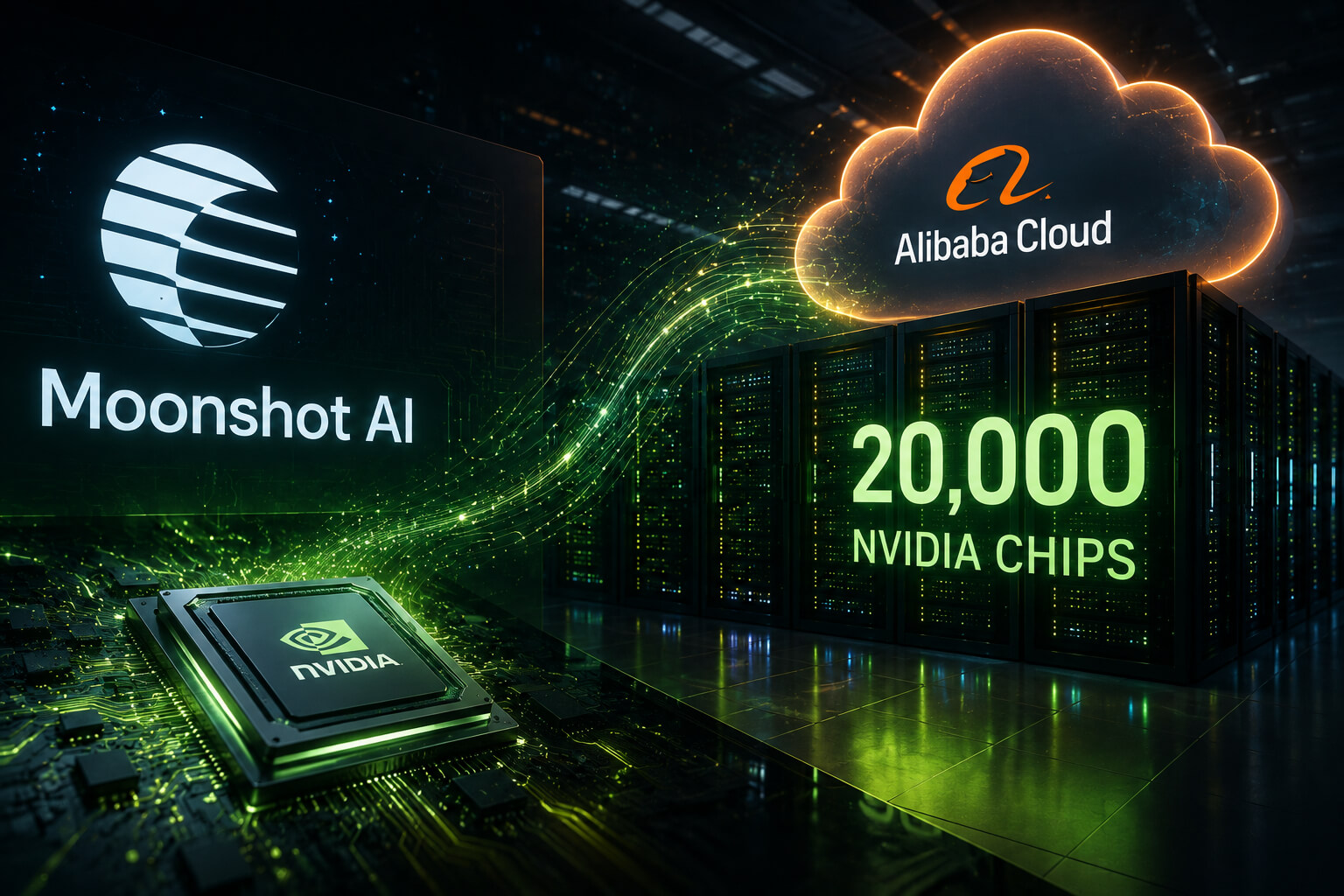
Chinese artificial intelligence startup Moonshot AI reportedly gained access to a computing cluster containing about 20,000 Nvidia chips through an agreement with Alibaba Group.
That is not a small infrastructure arrangement.
The cluster provides much of the computing power behind Moonshot’s Kimi AI models, according to a Bloomberg News report cited by Reuters. Alibaba is also one of the startup’s largest investors, creating a relationship that stretches beyond a conventional cloud contract.
The reported deal offers a clearer picture of how Moonshot has managed to develop increasingly capable AI systems while Chinese companies face tighter access to advanced semiconductor technology.
Alibaba Gives Moonshot Access to Serious Computing Power
Moonshot does not appear to own the entire chip cluster directly. Instead, the company reportedly accesses the hardware through an Alibaba computing agreement.
The arrangement covers roughly 20,000 Nvidia processors. Reports indicate that much of the cluster uses chips based on Nvidia’s Hopper architecture, the generation that includes widely used accelerators built for training and running large AI models.
Alibaba has invested heavily in Moonshot and expects companies within its investment portfolio to use Alibaba Cloud, according to the Reuters report.
That setup works for both sides.
Moonshot receives the enormous amount of computing capacity required to develop its Kimi models. Alibaba gains a major AI customer for its cloud division and a closer position inside one of China’s most closely watched AI startups.
It also shows how cloud infrastructure has become part of the investment strategy surrounding artificial intelligence. Funding a promising AI company is useful. Supplying the servers, chips and computing environment behind its products can be even more valuable.
The Cluster Is Closely Linked to Moonshot’s Kimi Models
Moonshot is best known for Kimi, its family of generative AI models and consumer-facing assistant products.
The company has been pushing Kimi beyond basic chatbot functions, with newer systems designed for more complicated reasoning, coding and agent-style tasks. Reports surrounding the Alibaba agreement suggest the Nvidia cluster provides a significant share of the computing capacity used by these models.
This matters because modern AI development depends heavily on scale.
A strong research team still needs access to thousands of specialised processors, high-speed networking, large amounts of memory and data-centre infrastructure. Without that hardware, training a frontier model becomes painfully slow or simply unrealistic.
The reported 20,000-chip cluster puts Moonshot in a far stronger position than smaller AI startups that must compete for limited cloud capacity.
It also helps explain how the company continues to release models intended to challenge larger Chinese technology groups and well-funded developers in the United States.
Nvidia Hardware Remains Important to China’s AI Industry
China has spent years trying to reduce its reliance on foreign semiconductor technology. Yet Nvidia hardware still appears to sit beneath some of the country’s most ambitious AI projects.
That is the uncomfortable part of this story.
US export controls have restricted the sale of advanced AI chips to China, while Nvidia has repeatedly adapted its product range to comply with changing rules. Chinese developers, meanwhile, have turned to older processors, modified chips, domestic accelerators and cloud-based computing arrangements to secure enough capacity.
The Moonshot agreement illustrates how access does not always involve an AI laboratory purchasing chips directly. A startup may instead rent computing power from a larger domestic cloud provider that already operates substantial infrastructure.
Reuters said it could not independently verify every detail of the reported arrangement. Alibaba also denied claims that it supplied Nvidia H200 processors to Moonshot, according to reports covering the Bloomberg investigation.
The distinction is important. The existence of a large Nvidia-powered cluster does not necessarily confirm exactly which chip models were used, when they were acquired or how the hardware moved through the supply chain.
Alibaba Is Building More Than a Cloud Business
Alibaba has made artificial intelligence a central part of its wider technology strategy.
The company develops its own Qwen AI models, sells cloud computing services and invests in outside AI startups. Moonshot fits neatly into that structure.
Alibaba can support a promising model developer while increasing demand for its own cloud platform. At the same time, lessons from Moonshot’s workloads could help Alibaba improve the infrastructure it offers to other AI customers.
The relationship resembles the increasingly connected AI ecosystems emerging elsewhere.
Major cloud companies are no longer just selling server space. They are investing in model developers, supplying specialised chips and tying those companies to their platforms through long-term computing agreements.
The money and the machinery now travel together.
The Deal Shows Where the Real AI Competition Is Happening
AI competition is often discussed as a contest between individual models: Kimi against ChatGPT, Qwen against Claude, or one benchmark score against another.
The infrastructure underneath those systems may be more decisive.
Moonshot’s access to around 20,000 Nvidia chips suggests that China’s leading AI startups are not relying on clever software alone. They are securing industrial-scale computing capacity through alliances with companies that already have data centres, cloud platforms and financial muscle.
That makes Alibaba’s role particularly significant. It is acting as an investor, infrastructure provider and potential distribution partner at the same time.
Moonshot gets room to build. Alibaba gets another reason for AI developers to stay inside its ecosystem.
The arrangement may also become a test case for how effectively semiconductor restrictions can limit access to advanced computing. Hardware controls can block direct purchases, but cloud contracts and existing domestic chip inventories make the picture far less tidy.
Moonshot’s Kimi models may carry the startup’s name. Behind them, however, sits a much larger machine involving Alibaba’s capital, its cloud network and thousands of Nvidia processors.
That machine is becoming just as important as the model itself.