

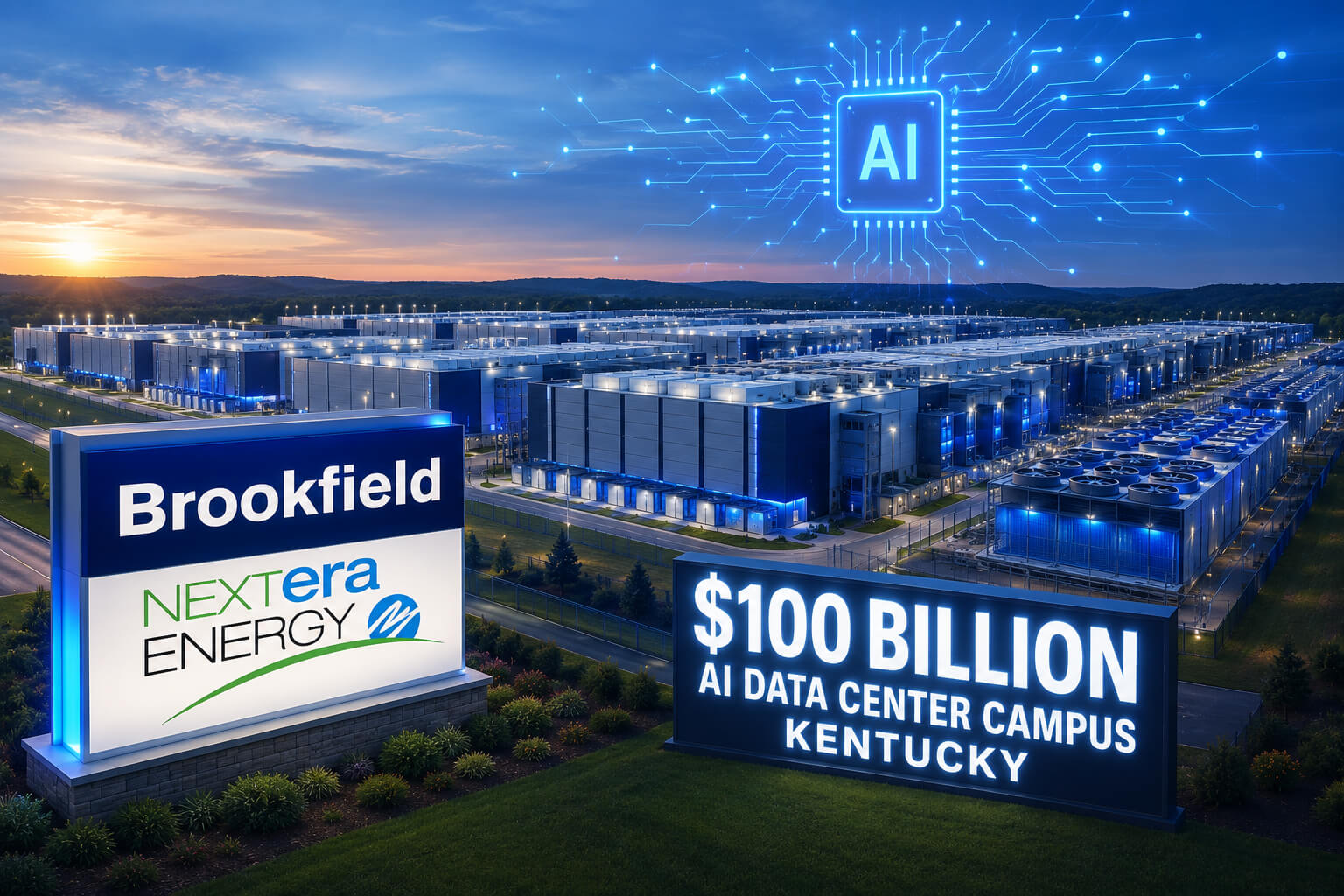
A former uranium enrichment site in western Kentucky could become one of the largest artificial intelligence infrastructure projects in the United States.
Brookfield and NextEra Energy have joined a broader coalition to develop a privately funded data center campus at the US Department of Energy’s Paducah Site. The proposed investment could eventually reach $100 billion.
That headline figure is enormous. Still, the project is not simply about filling warehouses with servers. It combines computing facilities, natural gas generation, battery storage and existing industrial infrastructure on a single site.
The campus is expected to begin operating in 2028, with full development targeted for 2032.
An Old Nuclear Site Finds a New Technology Role
The Paducah Site has a complicated history.
The facility opened during the 1950s as a uranium enrichment plant. It initially supported US nuclear weapons production before later supplying enriched uranium for commercial nuclear reactors. Commercial enrichment ended in 2013.
Now, the same location is being positioned as a foundation for AI-era infrastructure.
The site already has high-capacity electricity connections, water facilities, fiber connectivity, road access and large areas of industrial land. Those features could remove some of the early obstacles that often delay major data center projects.
Building a hyperscale campus from scratch usually means years of negotiations over transmission lines, water access, permits and local infrastructure. Paducah already has much of that groundwork in place. That does not make the project simple, but it gives the developers a meaningful head start.
The Campus Could Support More Than 1.2 Gigawatts of Computing
Once fully developed, the Brookfield NextEra Kentucky data center campus is expected to support more than 1.2 gigawatts of computing capacity.
The site could also have up to 1.8 gigawatts of utility capacity. That would place it among the largest planned data center developments in the country.
Brookfield is expected to lease land from the Department of Energy and develop and operate the data center portion of the project. The company has steadily expanded its exposure to digital infrastructure as demand for cloud computing and AI accelerators continues to grow.
NextEra Energy will handle the power side.
Its proposed infrastructure includes up to 2 gigawatts of natural gas-fired generation and as much as 2.6 gigawatts of battery energy storage. Together, those resources would provide up to 4.6 gigawatts of dedicated generation capacity as the campus expands.
Power Is Becoming the Real AI Bottleneck
AI companies can order more processors. Finding enough electricity to run them is harder.
Modern AI data centers consume power on a scale once associated with heavy industrial plants or entire cities. Training large models requires enormous computing clusters, while the rapid expansion of AI inference creates a more permanent, around-the-clock demand.
That has pushed developers toward projects where power generation and data center construction move together.
The Kentucky plan takes that idea further than most. Instead of relying entirely on the existing grid, the developers want to build new generation and battery capacity specifically for the campus.
Any excess electricity could potentially flow into the surrounding grid. The companies also say the project will follow the US government’s Ratepayer Protection Pledge, which aims to prevent data center development costs from being passed to residential electricity customers.
It is an important promise. Whether the project can maintain that separation as construction progresses will probably face close regulatory and public scrutiny.
Local Utilities Will Help Deliver the Electricity
Brookfield and NextEra are not working alone.
Big Rivers Electric Corporation is expected to provide wholesale electricity service. Jackson Purchase Energy Cooperative will manage retail power delivery, while Paducah Power System will support the project at the community level.
Some parts of the power arrangement will still require review and approval from the Kentucky Public Service Commission.
The project is expected to create approximately 8,000 construction jobs and around 600 permanent operational positions. Those numbers are significant for western Kentucky, although large data center projects typically generate far more temporary construction work than long-term employment.
The $100 Billion Figure Covers More Than Buildings
The proposed $100 billion investment should not be viewed as the cost of constructing a few data center buildings.
A large portion of that amount would likely cover servers, networking systems, AI chips, cooling technology and other computing equipment installed over several phases. Dedicated power plants, storage systems and transmission infrastructure will add billions more.
The project also remains subject to negotiations and the execution of final agreements. No major technology tenant has been publicly confirmed.
That distinction matters. Large infrastructure announcements can change considerably before construction reaches its final stage. Capacity targets may shift, timelines may move and investment will likely arrive in phases rather than as a single $100 billion commitment.
Federal Land Is Emerging as an AI Infrastructure Shortcut
The Paducah development reflects a broader US strategy: use federally controlled industrial sites to accelerate construction of data centers and power projects.
These locations can offer existing transmission capacity, fewer land acquisition problems and a clearer path through certain permitting processes. They may also reduce the local resistance faced by data centers proposed near residential communities.
The Department of Energy selected Paducah as one of several federal locations being considered for private AI infrastructure and electricity generation projects.
For technology companies, that could create a new path to capacity. Instead of competing for space and electricity in established data center markets, developers can build large campuses around underused federal industrial assets.
Kentucky Could Become a Major Stop on the AI Infrastructure Map
The biggest AI projects are no longer confined to Northern Virginia, Texas, Arizona or the Pacific Northwest.
Power availability is reshaping the map.
Kentucky offers land, existing industrial infrastructure and access to regional electricity systems. The Paducah site also carries something increasingly valuable in the data center business: room to build at a genuinely massive scale.
Whether the entire $100 billion vision becomes reality remains uncertain. The first operations are still years away, final documentation must be completed and customers will need to commit to the campus.
Even so, the proposal shows where the AI race is heading. The battle is no longer only about who designs the strongest model or secures the most advanced chips.
It is also about who can find the land, electricity and capital to keep those machines running.