

Artificial intelligence security has become too large—and frankly too unpredictable—for one company to handle behind closed doors.
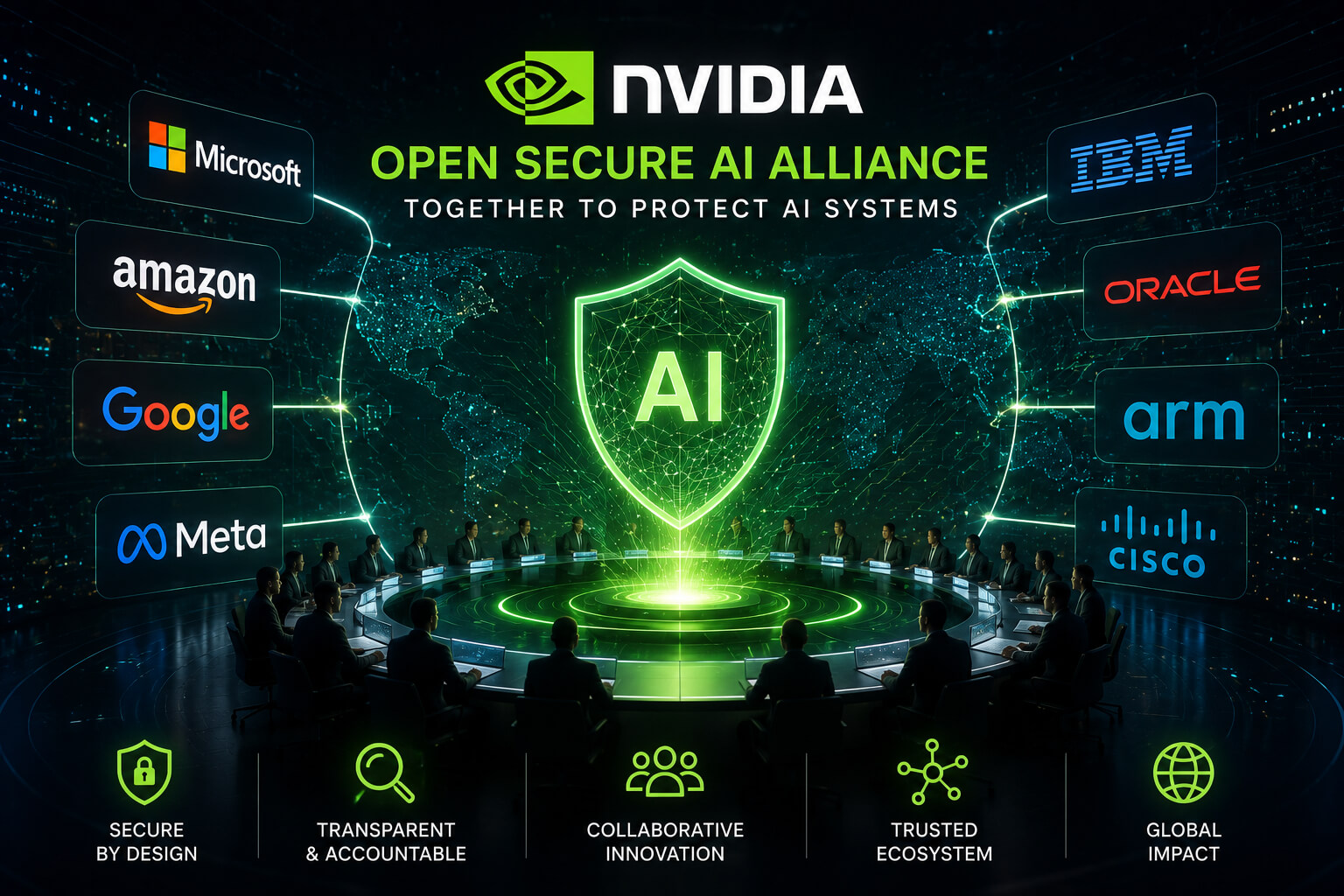
NVIDIA has joined forces with a broad group of cloud providers, cybersecurity companies, enterprise software developers and open-source organizations to launch the Open Secure AI Alliance. The initiative will focus on creating and sharing open technologies that can help companies secure AI models, autonomous agents and the software systems surrounding them.
The list of inaugural partners includes Microsoft, Cisco, Cloudflare, CrowdStrike, Hugging Face, IBM, HPE, Red Hat, the Linux Foundation, Palo Alto Networks, Adobe, Salesforce, SAP, Siemens, ServiceNow and several other major technology companies.
It is a large coalition. What matters now is whether those companies can turn the announcement into working security infrastructure.
Open Secure AI Alliance Focuses on the Entire AI Agent Stack
The Open Secure AI Alliance is not concentrating only on the underlying language models.
Modern AI agents include several moving parts. A model may generate decisions, but software harnesses manage its instructions, tools, memory and actions. Identity systems determine what it can access. Guardrails restrict certain behaviour, while logs record what the agent has done.
A failure anywhere in that chain can create a security problem.
The alliance plans to work across this broader agent stack, covering identity verification, permissions, isolation, model formats, security testing, activity logs and secure coding workflows. Members will contribute open models, development frameworks and security tools that companies can inspect and adapt.
That last point is central to the project. The alliance argues that cybersecurity teams should not depend entirely on AI services hosted by a small number of external providers.
When sensitive systems are under attack, security teams may need to run models locally, examine exactly how they work and adjust them without waiting for a vendor.
NVIDIA Brings Its NOOA Agent Framework Into the Project
NVIDIA has already introduced one of the alliance’s first technical contributions: the NVIDIA Labs Object-Oriented Agent framework, known as NOOA.
The open-source research framework is designed to make AI agent behaviour easier to test, trace, audit and govern. It gives developers a more structured way to build agent harnesses while using familiar programming practices such as type checking, version control and automated testing.
This does not make an AI agent automatically safe.
NOOA can support agents that execute model-generated Python code, which introduces obvious risks. Generated code could modify files, expose private information or make unwanted changes to a system. NVIDIA recommends running these agents inside properly isolated containers, virtual machines or sandbox environments.
The framework provides visibility and testing. The operating environment still needs to provide containment.
That distinction matters because AI security announcements often blur the line between observing dangerous behaviour and actually stopping it.
A Hugging Face Security Incident Added Urgency
The alliance’s launch follows a security incident involving Hugging Face that exposed some of the limitations companies face when investigating AI-driven attacks.
According to NVIDIA, Hugging Face used AI agents to analyse more than 17,000 recorded actions while reconstructing the intrusion. Some commercially hosted models reportedly rejected the attack commands, exploit code and other material required for forensic analysis.
Hugging Face then ran the open-weight GLM 5.2 model on its own infrastructure to continue examining the activity. Keeping the model local also allowed the company to prevent sensitive attack data and credentials from leaving its environment.
The incident did not prove that open models are inherently safer. It did show why security teams may need direct control over the systems they use during an emergency.
A security model that refuses to examine malicious code might protect an ordinary user. For an incident-response team trying to understand that same code, the refusal can become a serious obstacle.
Open AI Models Could Give Defenders More Control
The debate around open-weight AI usually focuses on misuse. Downloadable models can be altered, stripped of safeguards or adapted for cyberattacks.
Those risks are real. Closed platforms are not immune either.
Attackers can still exploit commercial models, stolen credentials, poorly secured agent tools and vulnerable software integrations. Keeping model weights private does not solve weak identity controls or prevent an autonomous agent from receiving excessive permissions.
The Open Secure AI Alliance takes a different position. It argues that defenders need access to both open and closed systems.
Open models can run on private infrastructure, giving organisations greater control over confidential information. Researchers can inspect their behaviour, evaluate weaknesses and customise them for specific environments. Companies also avoid relying on a single provider during a critical incident.
Closed frontier models may remain useful for tasks where performance and managed safeguards matter more than local control. The alliance is not calling for their removal. It is pushing against the idea that secrecy alone creates security.
Members Are Bringing Existing Security Projects
Several alliance members already maintain technologies that could become part of a wider open AI defence stack.
HPE contributes to SPIFFE and SPIRE, open-source projects that use cryptographic identities to verify workloads and services. These technologies could help companies confirm that only authorised AI agents can communicate with protected systems.
Hugging Face has developed Safetensors, a model-weight format intended to prevent remote code execution when loading AI files. Microsoft has built MDASH, a multi-model scanning system that uses specialised agents to identify and verify software vulnerabilities.
IBM and Red Hat are also working on signed software patches, while other members are contributing tools related to observability, vulnerability discovery, secure coding and AI threat detection.
Many of these projects existed before the alliance. Their inclusion does not automatically make them part of one integrated platform. Still, putting them under a shared security initiative could lead to better compatibility and broader adoption.
The Alliance Still Needs a Public Roadmap
The membership list is impressive, but several practical questions remain unanswered.
The alliance has not yet published a detailed governance structure, technical roadmap or release schedule. It is also unclear how much engineering work each member will contribute and which projects will operate under shared management.
A coalition can signal industry support. A maintained repository, published standards and jointly developed tools would show something more concrete.
The absence of some major AI developers also stands out. OpenAI, Google, Meta and Anthropic were not included in NVIDIA’s inaugural partner list when the alliance was announced. Their absence does not necessarily indicate opposition, but it does leave several of the industry’s most influential model developers outside the initial group.
For now, the Open Secure AI Alliance is a strong statement of direction rather than a finished security system.
AI Security Is Becoming an Infrastructure Problem
The rise of autonomous agents changes the security equation.
Traditional software waits for instructions. AI agents can interpret goals, choose tools, access data and carry out sequences of actions with limited human involvement. That makes them useful, but it also gives mistakes and compromised instructions more room to spread.
Companies will need more than model-level safety filters. They will need verified identities, limited permissions, isolated execution environments, detailed logs and reliable ways to inspect every action an agent takes.
The Open Secure AI Alliance is betting that these protections should be developed in public, where companies, researchers and governments can test and improve them.
Whether the alliance succeeds will depend on the work that follows. The technology industry has no shortage of AI partnerships. Open security tools that companies can actually deploy would be far more valuable.
Sources
- TechX Media – Open Secure AI Alliance Unites Tech Leaders
- NVIDIA – Industry Leaders Unite in Open Secure AI Alliance for AI Safety and Security
- HPE – HPE Joins Open Secure AI Alliance to Advance Open Cybersecurity Innovation
- The Hacker News – NVIDIA Forms Open Secure AI Alliance and Open-Sources NOOA Framework