

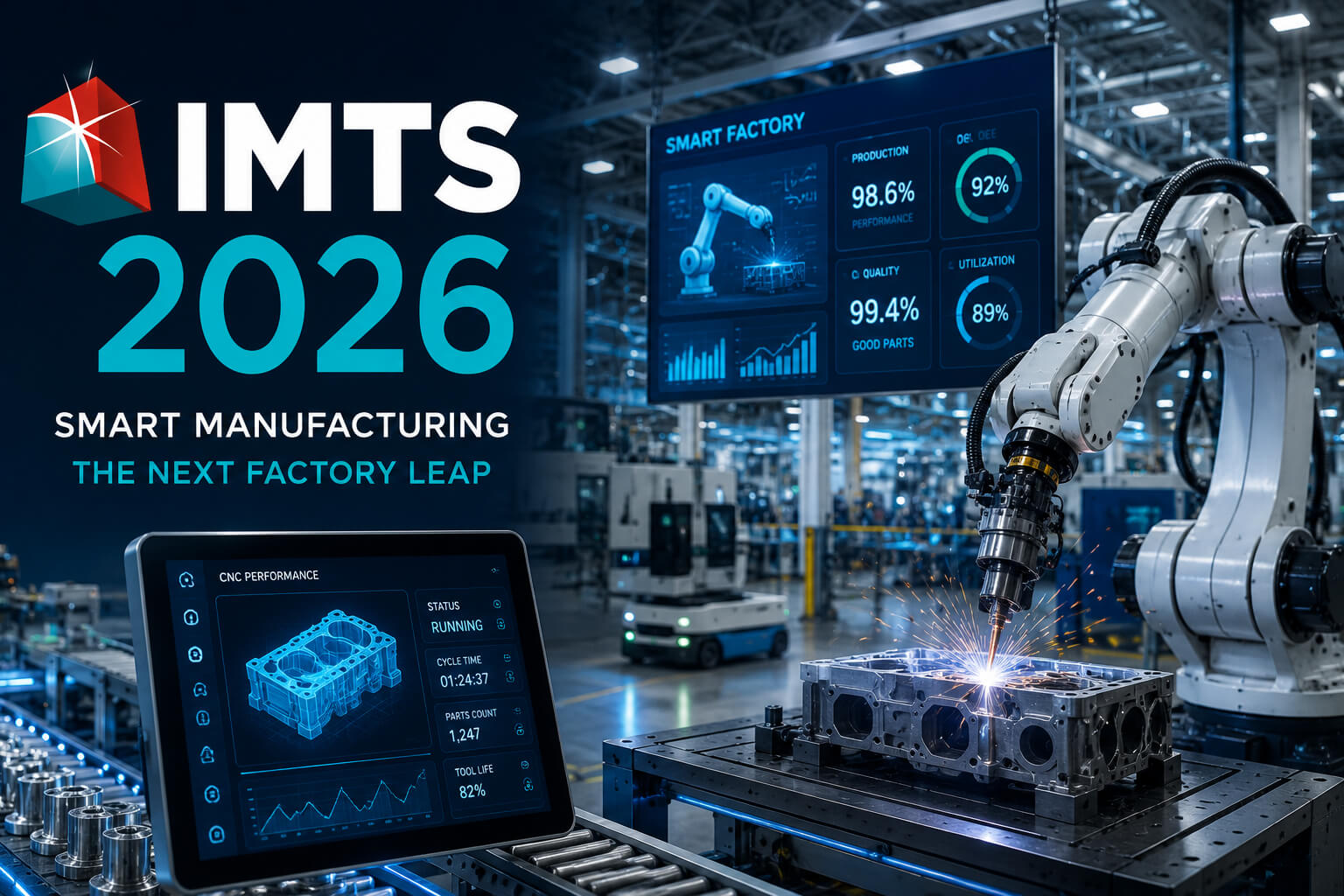
Manufacturing is getting squeezed from both sides. Factories need to produce more. Customers want faster delivery. Skilled labor is still hard to find. Costs are not exactly getting friendlier either.
That is why IMTS 2026 is being positioned as more than a big equipment showcase. The International Manufacturing Technology Show will put a sharp focus on the technologies that can help manufacturers do more with the people, machines, and floor space they already have.
The event will run from September 14 to 19, 2026, at McCormick Place in Chicago, bringing together more than 86,000 registrants, around 1,800 exhibitors, and 10 Technology Sectors across roughly 1.2 million square feet of exhibit space. That is a lot of machinery. But the bigger story is productivity.
Smart Manufacturing Is Moving From Buzzword to Shop Floor Reality
For years, smart manufacturing sounded like something reserved for huge industrial giants with deep pockets. Now the conversation is changing.
At IMTS 2026, the attention will be on automation, digitally connected factories, AI-enhanced systems, machine controls, software, tooling, workholding, metrology, robotics, and other technologies that can actually remove friction from daily operations. Not in a futuristic, glossy-video way.
More like: Can this machine run longer without someone standing beside it? Can this workflow reduce rework? Can this software stop operators from wasting time chasing data? Can a cobot help a smaller shop take on more work without hiring five more people? That is where the real pressure is.
Industrial AI Gets Its Own Spotlight
AI will also have a bigger role at IMTS 2026. The show’s conference lineup includes a new IMTS Industrial AI Conference, scheduled for September 16, focused on practical AI knowledge for manufacturers. The full conference program includes nine conferences and more than 90 sessions covering automation, artificial intelligence, machining, systems integration, additive manufacturing, metrology, software, tooling, and cost justification.
That detail matters. Industrial AI is not the same conversation as consumer chatbots. Manufacturers are looking for AI that can help with inspection, maintenance, scheduling, quoting, design support, process optimization, quality control, and workforce training.
Some companies are still cautious. Fair enough. Factory mistakes are expensive. But ignoring AI is becoming harder when competitors are using it to reduce downtime, speed up quoting, and make better use of production data.
Cobots, Automation, and the Labor Problem
The labor shortage is still sitting in the middle of the manufacturing conversation. IMTS 2026 will highlight technologies that help manufacturers extend unattended operations and reduce repetitive tasks. Collaborative robots, or cobots, are expected to be visible across the show’s technology sectors, giving manufacturers a chance to test how easy these systems are to program and use in real shop environments.
That is important for smaller manufacturers. A lot of job shops do not have large engineering teams waiting around to integrate complex automation. They need tools that can be installed, understood, and put to work without turning the whole business upside down.
This is why the next leap in manufacturing may not come from one dramatic invention. It may come from hundreds of smaller improvements: better machine monitoring, faster changeovers, automated loading, smarter inspection, digital work instructions, and software that connects the messy middle of production.
Job Shops May Have the Most to Gain
Large manufacturers usually get the early attention when new technology arrives. But IMTS 2026 is also speaking directly to job shops and contract manufacturers. These businesses often deal with short runs, shifting customer demands, tight margins, and limited staffing. One missed quote or delayed job can hurt.
Automation and digital workflows can help these shops compete differently. Not by becoming giant factories overnight. That is not realistic. But by cutting non-value-added work, reducing manual handoffs, improving scheduling, and making machines more productive during the hours already available.
The show will also include an IMTS Job Shops Workshop on September 15, covering topics such as industry economics, automation integration, AI, and the future of manufacturing.
Manufacturing Tech Is Becoming a Competitiveness Issue
There is another angle here that should not be missed. Advanced manufacturing technology is no longer just about buying newer machines. It is becoming a competitiveness issue for companies and economies.
AMT, which owns and produces IMTS, has framed the event around helping manufacturers strengthen productivity and industrial performance. Douglas K. Woods, president of AMT, said the technologies at IMTS show how manufacturers can do more with the teams they already have. That is a simple point, but it lands.
The manufacturers that modernize workflows, connect systems, and adopt useful automation may gain speed. Those that wait too long may find themselves trapped by older processes, higher labor pressure, and slower production cycles.
The Next Factory Leap Looks Practical, Not Flashy
IMTS 2026 is not only about giant machines on display. The more interesting story is how manufacturing technology is becoming easier to apply. Automation is getting more flexible. Software is moving closer to the shop floor. Artificial intelligence is being shaped for industrial problems. Cobots are becoming less intimidating. Digital workflows are slowly replacing paper-heavy processes.
Some of it will be exciting. Some of it will look boring. The boring parts may matter most. Because if a manufacturer can ship faster, reduce downtime, improve quality, and make life easier for operators, that is not hype. That is a better factory.
Sources
- Industrial Equipment News – IMTS 2026 to Spotlight Tech Powering Manufacturing’s Next Leap
- AMT – IMTS 2026 Reveals How Manufacturers Can Redefine Productivity
- IMTS – IMTS 2026 Conferences Lineup
- ManufacturingTomorrow – IMTS 2026 Conferences Lineup