

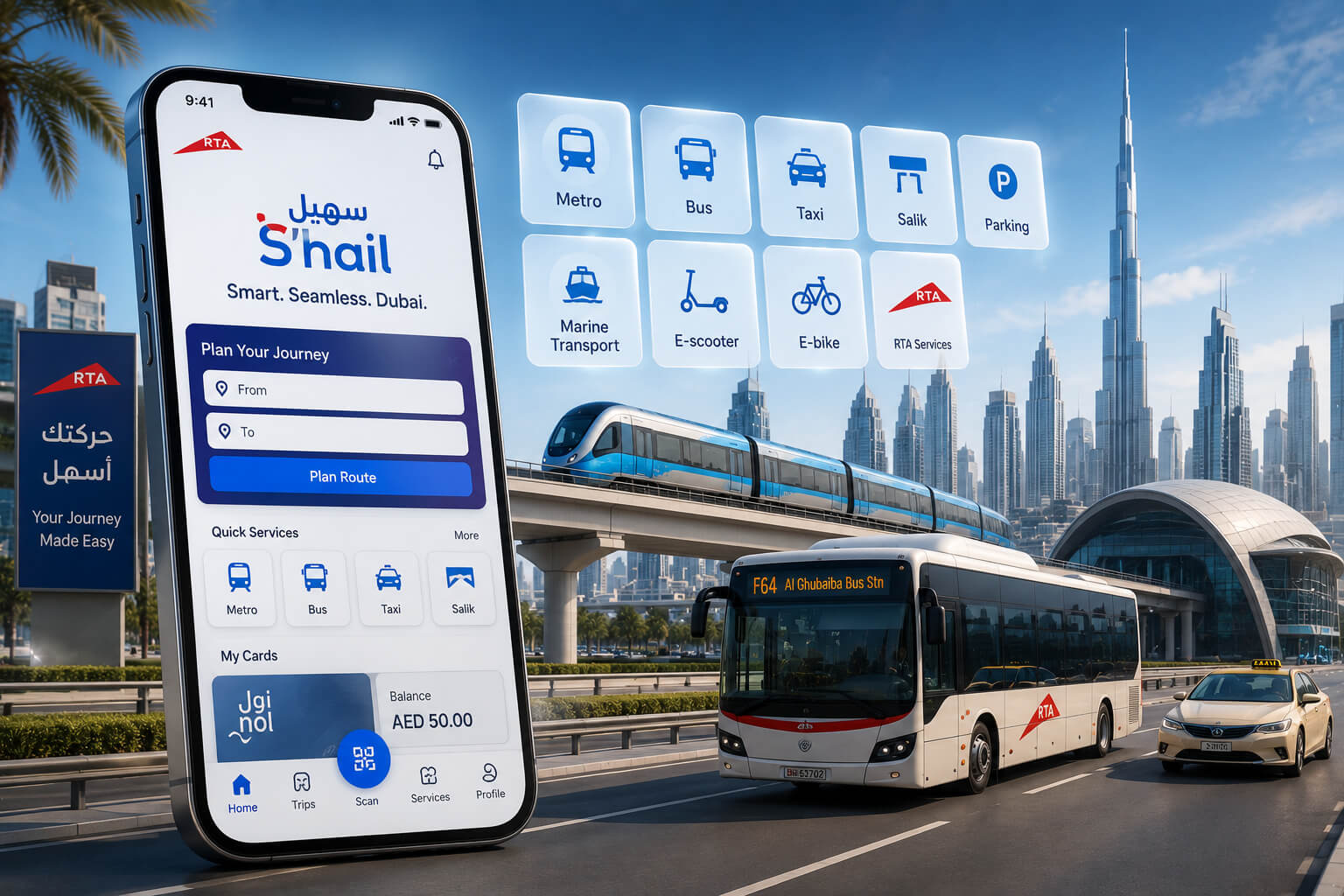
Dubai’s transport apps are not just sitting quietly on people’s phones anymore.
The Roads and Transport Authority has been pushing more mobility services into its digital channels, and the S’hail app is getting a bigger role in that shift. The app, already known as one of Dubai’s main journey-planning tools, has expanded with more services linked to nol cards and new mobility features designed to make travel across the city feel less scattered.
It sounds like a small app update. It is bigger than that. Dubai is trying to make transport feel like one connected system, not a collection of separate options where commuters jump between metro timings, taxi bookings, bus routes, parking tools, and card services.
S’hail Becomes a Bigger Part of Dubai’s Mobility System
The RTA S’hail app brings together Dubai Metro, Dubai Tram, buses, taxis, ride-hailing, smart rental vehicles, inter-city bus planning, and public transport information in one place. RTA describes it as an all-in-one app for moving around Dubai, with features for route planning, taxi booking, nol account management, and real-time traffic updates.
That matters because Dubai’s mobility network has become too wide for simple travel apps. A commuter may use the Metro in the morning, a taxi at lunch, a bus connection later, and nol services somewhere in between. S’hail is being positioned as the app that ties those small decisions together. Not glamorous, maybe. But useful.
New Services Add More Weight to the App
RTA said S’hail introduced services linked to the automated fare collection system, including nol card services, along with new features and enhancements that improve the integrated mobility experience. The authority also added 14 services to S’hail under the “Mobility in Dubai” channel as part of wider digital integration across government platforms.
This is where the app starts to look less like a route planner and more like a transport control point for residents and visitors. Instead of only asking, “Which way should I go?”, users are being nudged toward a broader app experience: planning, checking, paying, booking, and managing parts of the journey in one digital space.
Dubai’s Transport Apps Are Seeing Heavy Growth
The timing is not random.
RTA’s digital channels generated AED 5.3 billion in revenue in 2025, up 20.6 percent from the previous year. Digital transactions crossed 628 million, while digital adoption reached 96 percent, according to Gulf News and Dubai Media Office reports.
Smart apps are also becoming a bigger part of how people interact with RTA services. RTA said customer usage of services through smart apps rose by more than 25 percent, a 40 percent year-on-year increase. Active users of the RTA Dubai app passed 1.2 million in 2025.
The combined annual visits to RTA apps reached 68 million, up 144 percent from 2024. Requests for enquiry and journey-planning services also climbed to 48 million, a 48 percent rise. Those numbers explain why S’hail matters now. People are already using digital transport services heavily. RTA is simply making the app carry more of the journey.
Why This Fits Dubai’s Smart City Push
Dubai has been building its smart mobility story for years, but the real test is not always the futuristic stuff.
Robotaxis, AI traffic systems, and smart stations get attention. Fair enough. But daily transport also depends on basic digital convenience: fewer steps, clearer routes, faster access, and services that do not make users feel like they are dealing with five different systems at once.
S’hail sits in that practical layer. RTA has said the next phase of its digital transformation will focus on expanding artificial intelligence and emerging technologies in service design, while strengthening integration with government digital platforms. That means apps like S’hail are likely to become more proactive, not just reactive. More reminders. More recommendations. More connected services. Maybe less tapping around.
The Real Story Is Convenience
The expansion of the RTA S’hail app is not just about adding buttons.It reflects how Dubai wants mobility to feel: connected, digital, and easier to manage from a phone. For residents, that could mean smoother daily travel. For visitors, it could reduce the usual confusion of figuring out metro routes, bus links, taxi options, and payment systems.
Not every app update deserves attention. This one does, because it points to where Dubai’s transport system is heading. Less fragmented. More digital. More dependent on one connected mobility experience.
Sources
- TechX Media: RTA S’hail app expands Dubai mobility services
- Dubai Media Office: RTA digital channels generated AED 5.3 billion in 2025
- Roads and Transport Authority: S’hail app
- Gulf News: How AI and digital services drove AED 5.3 billion in RTA revenue