

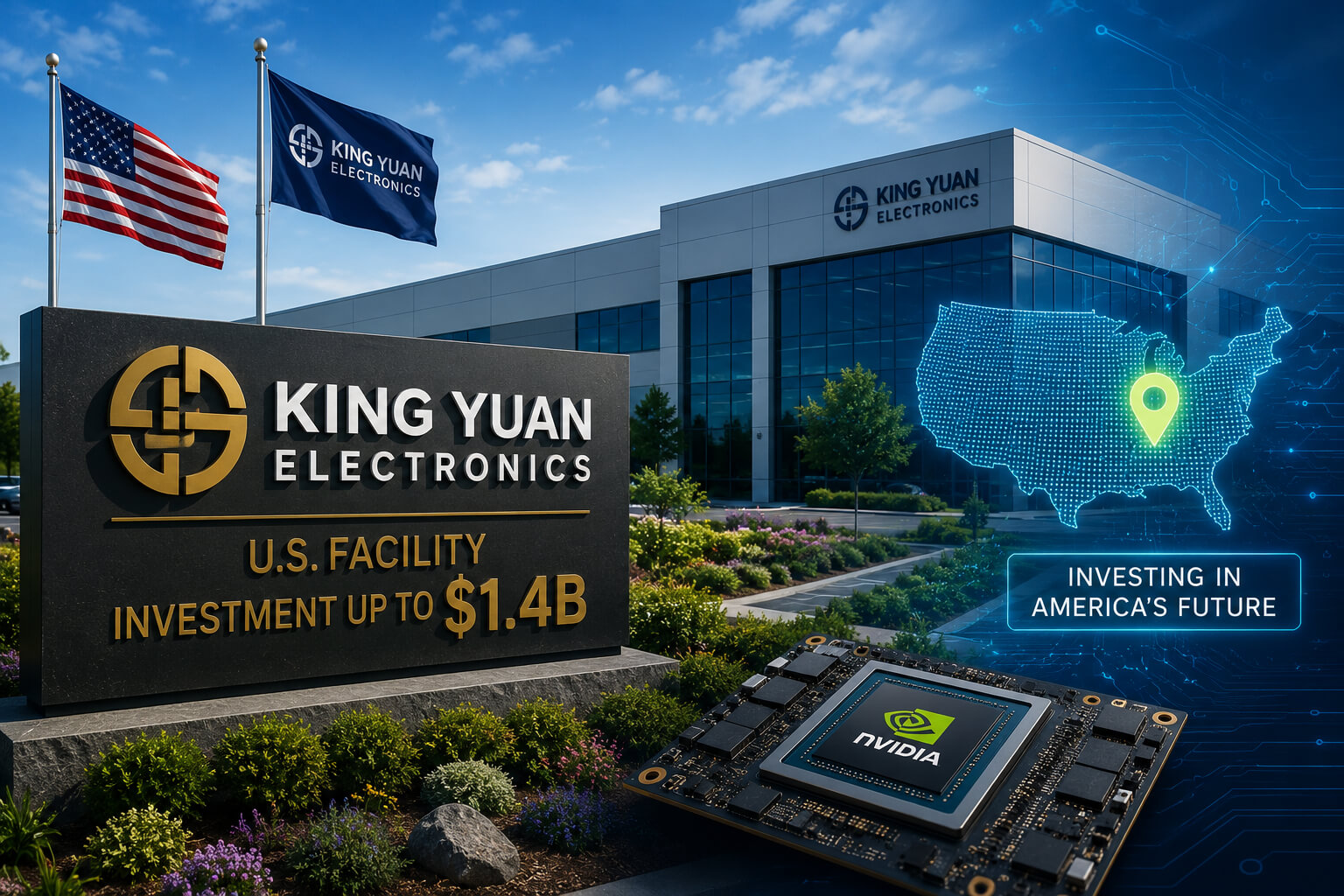
King Yuan Electronics is preparing for a much bigger move into the United States.
The Taiwanese chip-testing company, known as a supplier to Nvidia, said it plans to invest up to $1.4 billion to build a new facility in the US. The announcement adds another piece to the wider semiconductor shift now happening across America, where chip companies and their partners are trying to get closer to customers, reduce supply chain risk, and keep up with demand from artificial intelligence hardware.
King Yuan Electronics Looks Beyond Taiwan
King Yuan Electronics, also known as KYEC, plays in a less flashy but very important part of the chip industry: testing.
That may not sound as exciting as GPUs, AI models, or data centers. But every advanced chip needs to be tested before it goes into servers, devices, or cloud infrastructure. When AI chip demand rises, testing demand rises with it. That is where companies like KYEC become harder to ignore.
The company said the planned US investment is meant to support operational growth and strengthen its role in the global supply chain. In plain terms, KYEC wants more capacity in a market where AI chips are still moving fast and where major customers want stronger regional support.
Why This US Facility Matters
The US has been pushing hard to rebuild and expand semiconductor capacity, but manufacturing is only one part of the story.
Chips also need packaging, testing, logistics, power, skilled workers, and a whole network of suppliers around them. A new KYEC facility could help fill part of that gap, especially for high-performance chips used in AI servers and data centers.
This is not just about one Taiwanese company opening a building overseas. It points to a broader supply chain reshuffle. More chip-related work is moving closer to the US market, partly because of customer demand, partly because of geopolitics, and partly because companies do not want every critical step concentrated in one region.
Nvidia Connection Adds Weight
The Nvidia link is what makes this story stand out.
Nvidia’s AI chips have become central to the global AI boom, powering cloud platforms, enterprise AI systems, model training, and large-scale inference. That pressure does not only land on Nvidia. It spreads across the whole supplier network.
KYEC’s planned US expansion suggests that support companies around Nvidia are also scaling up, not just the headline chip designers and foundries. If AI demand keeps growing, suppliers involved in testing and related services could become even more important.
AI Chips Need More Than Manufacturing
Most people talk about chip production as if the whole process ends when silicon comes off the line. It does not.
Testing is one of those behind-the-scenes steps that can slow things down if capacity is tight. Advanced AI chips are expensive, power-hungry, and complex. They need strict testing before they can be shipped into high-value systems.
So, when KYEC says it wants to invest up to $1.4 billion in a US facility, it is not a small side note. It is another sign that AI infrastructure is becoming a full industrial buildout.
Factories. Test centers. Data centers. Power deals. Cooling systems. Supply agreements. The whole thing is getting bigger.
Semiconductor Supply Chains Keep Moving
The timing also fits the larger semiconductor trend.
Taiwan remains one of the most important centers in the global chip industry, especially because of companies like TSMC and their ecosystem of suppliers. But more firms are now adding capacity outside Asia, particularly in the US, as governments and customers push for more resilient supply chains.
KYEC has already been linked to rising AI chip testing demand, and earlier reports have described the company as a key testing partner for Nvidia and TSMC.
That makes the US facility plan feel less like a random expansion and more like a response to where the chip market is going.
The Bigger Picture
AI is not only changing software. It is changing where factories are built, where suppliers invest, and how countries think about technology security.
King Yuan Electronics’ planned $1.4 billion US facility shows how deep that shift is becoming. The companies behind AI chips are no longer just racing to design faster processors. They are also trying to build the physical support system needed to test, ship, and scale them.
Not glamorous, maybe. But very real.
And in the AI chip race, the quiet parts of the supply chain may end up mattering more than people expected.
Source: Reuters