

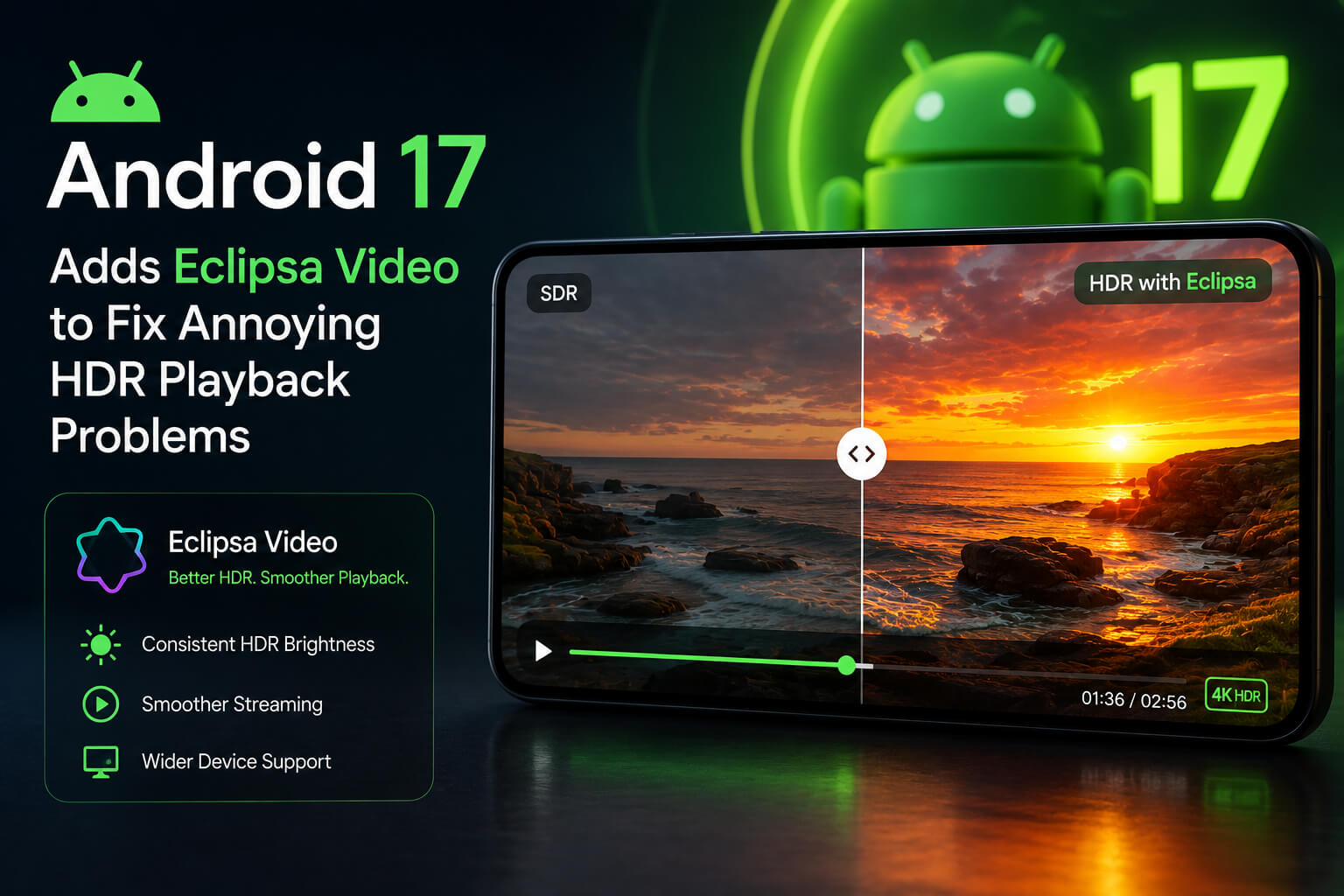
Android 17 is bringing a video upgrade that sounds technical at first, but the problem it solves is very familiar.
You are scrolling at night. A video suddenly blasts your screen with painful brightness. Or you watch the same HDR clip on another device and it looks strangely flat, dark, or washed out. HDR was supposed to make video better, richer, more realistic. In practice, it can sometimes feel like every screen is making its own decision.
Google wants to clean that up with Eclipsa Video, a new HDR standard built directly into Android 17. The goal is simple: make HDR video look more consistent across different displays, without forcing users to keep adjusting brightness settings manually. Google says Eclipsa Video is based on the open SMPTE ST 2094-50 specification, developed with Apple and NBCUniversal.
What Eclipsa Video Actually Does
Eclipsa Video gives compatible displays clearer instructions on how an HDR video should be shown.
That matters because screens are not equal. A premium TV can handle bright highlights differently from a mid-range smartphone. A tablet may tone-map video in another way. Without a shared standard, one video can look great on one display and uncomfortable on another.
Eclipsa Video tries to reduce that guesswork. It uses a consistent brightness baseline, called HDR reference white, so normal text, app interfaces, captions, and standard-range colors remain readable while HDR content plays.
Small thing? Maybe. But for social media feeds, video apps, and mobile viewing at night, it could make a real difference.
No More Blinding HDR Surprises
One of the most irritating HDR problems is sudden brightness.
A clip starts playing, the highlights kick in, and the screen feels too intense. Google specifically points to this kind of feed-scrolling problem as one of the issues Eclipsa Video is designed to fix.
Instead of letting the display push brightness however it wants, Eclipsa Video uses adaptive guidance. Bright details can still look bright on high-end screens, but they can also be scaled down more intelligently on smaller or less capable displays.
So the video does not have to lose its punch. It just should not attack your eyes in the process.
Better HDR Across Phones, Tablets, and TVs
The bigger promise here is consistency.
Google says Eclipsa Video carries frame-by-frame instructions that help preserve the intended colors, contrast, and mood of a video. In plain terms, the video brings its own visual notes with it, so a compatible screen has a better idea of how it should render each scene.
That could be useful not only for regular viewers, but also for creators. If someone grades a video to look a certain way, they do not want it looking harsh on a phone and dull on a TV. Eclipsa Video is meant to keep that creative intent more intact.
Android 17 Builds It Into the Platform
This is not just an app-level feature sitting on the side.
Starting with Android 17, Google says Eclipsa Video support is built directly into the platform. Devices running Android 17 with compatible HDR displays and compliance support should be able to take advantage of it natively.
That built-in support is important because HDR playback problems are not limited to one app. They show up across streaming platforms, social apps, camera captures, and shared videos. A platform-level fix has a better chance of becoming normal over time.
Developers Get Support Through Media3 and ExoPlayer
Google is also pushing developers and creators to adopt the standard.
The company says playback handling is built into Jetpack Media3, allowing ExoPlayer to support Eclipsa Video metadata automatically without extra player configuration. Google has also published implementation guidance for playback and capture.
That part matters quietly. A standard only becomes useful when apps, devices, and creators actually support it. Android 17 gives Eclipsa Video a strong starting point, but wider adoption will decide how visible the improvement becomes for everyday users.
Why This Android 17 Feature Matters
Eclipsa Video is not the kind of feature that will sell a phone by itself.
It is not flashy. It does not sound like an AI assistant, a foldable redesign, or a camera megapixel jump. But it targets one of those small daily annoyances that people feel immediately: video that looks wrong, too bright, or inconsistent depending on where it plays.
For Android 17, that is a useful kind of upgrade. Less dramatic, more practical.
If Eclipsa Video works as intended, users may not even think about it much. HDR videos should simply look better, feel more comfortable, and stay closer to what creators meant viewers to see.
And honestly, that is the point.